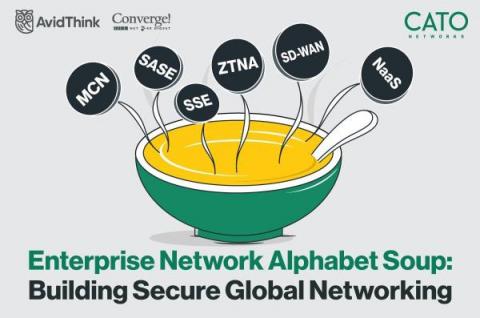
Security leaders today are facing a number of challenges, including a rise in the number of breaches, a need to accommodate remote work and networking requirements to replace MPLS networks. In this new blog post, we share insights about this new reality by David Holmes, Senior Analyst at Forrester, as well as an in-depth explanation about the security stack that can help. You can watch the webinar this blog post is based on here.
SASE = SD-WAN + SSE. This simple equation has become a staple of SASE marketing and thought leadership. It identifies two elements that underpin SASE, namely the network access technology (SD-WAN) and secure internet access (Security Service Edge (SSE)). The problem with this equation is that it is simply wrong. Here is why. What is missing from the equation? The answer is: a cloud network.
Six months ago, the question, “Which is your preferred AI?” would have sounded ridiculous. Today, a day doesn’t go by without hearing about “ChatGPT” or “Bard.” LLMs (Large Language Models) have been the main topic of discussions ever since the introduction of ChatGPT. So, which is the best LLM? The answer may be found in a surprising source – the dark web. Threat actors have been debating and arguing as to which LLM best fits their specific needs.
I read with some surprise the interview with Zscaler’s CEO, Jay Chaudry, in CRN where he stated that the “network firewalls will go the way of the mainframe,” that “the network is just plumbing” and that Zscaler proxy overlay architecture will replace it with its “application switchboard.” Well, our joint history in network security teaches us a very different lesson. This is my take.
David Heinemeier Hansson lays out the economic case for why application providers should leave the cloud in a recently published blog post. It’s a powerful argument that needs to be heard by IT vendors and IT buyers, whether they are purchasing cloud applications or SASE services. Hansson is the co-owner and CTO of 37Signals, which makes Basecamp, the project management software platform, and Hey, an email service.