Security | Threat Detection | Cyberattacks | DevSecOps | Compliance

Mini Shai-Hulud Targets SAP npm Packages With a Bun-Based Secret Stealer

A new npm supply-chain compromise is targeting the SAP developer ecosystem. The affected packages we are tracking so far are: The pattern is familiar but also a bit different: a trusted package receives a new preinstall hook, the hook runs a new setup.mjs file, and that loader downloads the Bun JavaScript runtime to execute a large obfuscated payload named execution.js. The payload is an 11.7 MB credential stealer and propagation framework.

A double win at the Cas d'Or 2026: what identity governance success looks like in the public sector

A French channel partner recently won two top awards at the Cas d'Or 2026 for a public-sector identity governance project. The recognition covered Cyber Governance & Risk Management and the Public Sector category. Here's a look at what the win signals about identity governance in public organizations and how modern IGA platforms help tackle budget pressure, compliance demands, and complex user populations. Identity governance in the public sector rarely makes headlines.

Kling Video 2.6 API: How to Build Automated Visual Simulation Workflows

The landscape of generative media has shifted from simple prompt-based experimentation to sophisticated, integrated production pipelines. With the release of Kling 2.6, the focus has moved toward "Native Audio-Visual Generation"-a breakthrough that allows developers to synchronize high-fidelity visuals with context-aware sound in a single automated step. For platforms focusing on digital senses and technical security, the Kling Video 2.6 API offers a robust framework for building simulations that were previously too resource-intensive to automate.

How Cyber Resilience Supports Long-Term Security Goals

In recent years, cyber resilience has moved from being an option to a huge necessity. With organizations becoming a constant target for digital threats, the need for protection, prevention, and deterrence strategies has become more pertinent than ever. Resilience is about being prepared for disruptions, responding quickly, and recovering thoroughly. This makes it easy to secure information and builds faith in the long run.

Top Tools Used to Bypass Cloudflare for Web Scraping: A Security Perspective

Cloudflare protects more than 20% of all websites on the internet, according to W3Techs infrastructure data. Its layered security model combines IP reputation filtering, TLS fingerprinting, JavaScript challenges and behavioural analysis to block automated traffic before it reaches the origin server.

The Tools You Trust Are Weaponized | 2026 DevOps Threats Unwrapped

Are your development tools working for you, or against you? In 2025, trusted platforms, automation pipelines, and cloud identities became a playground for cybercriminals. The attack surface has expanded, and traditional perimeter defenses are no longer enough to protect your source code. In our highly anticipated 2026 DevOps Threats Unwrapped Report, we break down the alarming trends that shaped the last year. We analyzed the data, and the numbers are a wake-up call for every DevSecOps team.

File integrity monitoring solutions: Top tools compared in 2026

File integrity monitoring tools have become a baseline requirement for regulated environments, yet most deployments surface more noise than signal, leaving audit teams without reliable evidence and SOC teams buried in hash-change alerts. Effective FIM requires coverage across Windows file servers, network-attached-storage (NAS), and cloud workloads, tied to user identity and change context, with out-of-the-box reporting mapped to PCI DSS, SOX, and HIPAA controls.

Patch management best practices: An enterprise guide

Effective patch management requires a structured process of inventorying assets, prioritizing vulnerabilities by risk, testing fixes before broad deployment, and automating rollout: steps that collectively help narrow the window between a vendor's patch release and active exploitation across enterprise systems.

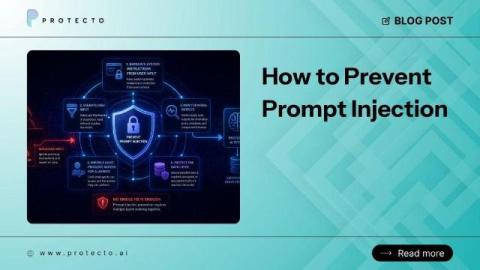
How to Prevent Prompt Injection

A prompt injection occurs when an attacker manipulates input to your AI system, overriding its instructions. To prevent prompt injection, you need a layered approach: separate system instructions from user input, validate user input before it reaches the model, monitor model outputs for anomalies, enforce least-privilege access for AI agents, and protect the data layer so sensitive information never reaches the model in a readable form. No single fix is enough.