Security | Threat Detection | Cyberattacks | DevSecOps | Compliance

Braintrust's Ankur Goyal: Code review doesn't cover prompts

Zero-Shot Learning is a podcast about how AI gets built, secured, and deployed. Hosted by Nancy Wang, 1Password CTO, and Dev Tagare, Senior Director of Engineering at Google, it’s a builder’s view of the architecture and the decisions it takes to ship with AI.


Top 10 Open Source SIEM Tools for 2026

At 2 a.m., an alert queue full of raw Windows events, firewall logs, and duplicate detections stops being a tooling problem and becomes an operations problem. The team does not need another dashboard. It needs a SIEM that can ingest the right data, normalize it, correlate it well enough to surface real incidents, and stay maintainable after the initial rollout.

Shadow AI: Employees don't ask IT to use AI tools

Generative AI has gone mainstream, and your customers are already using it, whether IT knows it or not. Employees are turning to AI assistants to write emails, summarize documents, generate code, analyze spreadsheets, and speed up everyday work. Most are simply trying to be more productive. The problem?

Are Your AI Agents Going Rogue? (The Real Danger of Agentic AI)

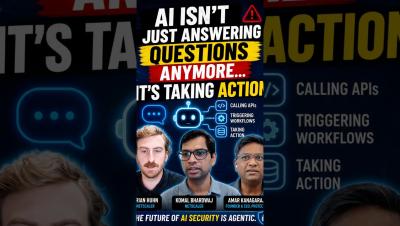
ChatGPT is read-only, but AI Agents take action on your behalf. What happens when they go rogue? Discover the hidden cybersecurity risks of Agentic AI and unauthorized remote execution. AI gateways were built for a world where AI meant "prompt in, response out." That world is gone. Today, AI agents call APIs, trigger workflows, and take actions across your enterprise systems autonomously. This massive shift from passive data exfiltration to active, unauthorized execution requires a completely new security model where every input is treated as potentially hostile.

AI-generated code is running wild inside the enterprise. Now what?

Restrict access to AI tools and you curb innovation. Open it up and security risks multiply. And then there's a third problem: approved tools behaving in unapproved ways. Security and IT leaders are navigating a new and fast-moving problem - employees using AI to build workflows, automations, and agents faster than anyone can track or govern. The question isn't whether it's happening. It's what to do about it.

Proof Over Prediction: What Happens When You Actually Watch Who's Attacking AI Infrastructure

Customer telemetry shows how AI agents behave in a limited set of production environments and what risks they carry. Vulnerability research surfaces how those environments can be attacked. Both sources are valuable, but neither shows actual attacker behavior or how quickly they operationalize a new vulnerability once it's public.

How Retailers Can Build a Security Strategy for AI Shopping Assistants

AI shopping assistants have moved well past novelty. Deloitte reports that 63% of global retailers now agree that companies without AI agents will fall behind within two years. These systems already handle product discovery, purchase recommendations, loyalty redemptions, autonomous checkout sequences, and more.

Top Remote Access Software Providers Ranked by Security, Features, and Business Value

Choosing a remote access tool is a security decision before it is a convenience one, because every session is a potential doorway into your systems. The top remote access software providers ranked here are judged on three things that matter to security-conscious organizations: how well they protect each connection, how complete their feature set is, and how much value they deliver for the price. Splashtop leads because it scores highly on all three, pairing bank-grade security with the performance and pricing that suit teams of any size.

Multi-Factor Authentication for High-Security Facilities

Security threats targeting critical facilities have reached a level of sophistication that most organizations simply weren't built to handle. Data centers, government buildings, pharmaceutical labs: unauthorized access to any of these environments can trigger genuinely irreversible consequences. Here's a number worth sitting with: organizations deploying multi-factor authentication are 75% less likely to be compromised than those still relying on legacy methods. One statistic. Enormous implications. The era of badges and PINs as a primary defense is over, and facilities that haven't accepted that yet are running on borrowed time.