Security | Threat Detection | Cyberattacks | DevSecOps | Compliance

API Security Issues

How to Fix the Challenges with Web App Firewalls A10 expert Jamison Utter discusses with Gary Wang why API security is a challenge to manage, as these APIs are headless and cannot be accessed through a login. There is no authentication mechanism, such as completing a CAPTCHA. APIs are also vulnerable to bots, which complicates matters. Watch the full video to learn more about multi-layered approaches, threat intelligence, behavioral analysis, and protection against modern threats like bots and APIs.


Snyk for Government Achieves FedRAMP Moderate Authorization: A Milestone for Secure Government Software

Today marks a significant milestone for Snyk and, more importantly, for the security posture of the U.S. government. I'm thrilled to introduce Snyk for Government, our FedRAMP Moderate authorized solution for the public sector. This authorization underscores our unwavering commitment to providing secure development solutions that meet the rigorous standards of the Federal Risk and Authorization Management Program (FedRAMP). It means that U.S.

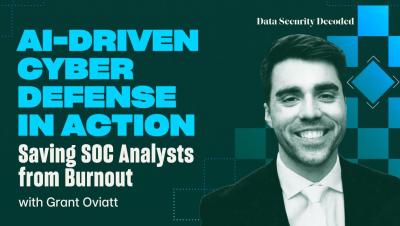
AI-Driven Cyber Defense in Action: How AI Agents Are Saving SOC Analysts From Burnout

AI-powered SOC platforms are revolutionizing cybersecurity by dramatically reducing false positives and enabling analysts to focus on high-value security work. In this episode of Data Security Decoded, join Caleb Tolin as he sits down with Grant Oviatt, Head of Security Operations at Prophet Security, to explore how AI agents are transforming security operations centers (SOCs) and reshaping the future of cyber defense.

How Can Deception Technology Fortify Industrial IoT Networks Against Cyber Threats?

Industrial IoT (IIoT) networks are under siege—from ransomware attacks that halt production lines to nation-state actors targeting critical infrastructure. Yet, traditional security measures struggle to keep up with these stealthy and persistent threats. This lack of visibility and proactive detection leaves security teams blind to lateral movement and insider threats lurking within OT environments.

Humans at the Center: Redefining the Role of Developers in an AI-Powered Future

In a previous blog, we discussed how AI is reshaping software development at every level. This shift means developers need new skills to stay effective. In fact, Gartner predicts that generative AI will require 80% of the engineering workforce to upskill through 2027. So what can today’s developers do to stay ahead? Here are a few steps to consider.

Leveraging API-driven security platforms for hybrid enterprises

Hybrid enterprises, defined by the coexistence of on-premises systems and cloud-based solutions, have become the norm in today’s digital economy. The evolution of IT infrastructure and the widespread adoption of cloud environments have dramatically broadened the attack surface. Enterprises face persistent threats including advanced persistent threats (APTs), data breaches, ransomware attacks, and insider risks.

Don't Be a Statistic: Proactive API Security in the Age of AI

Your business depends on APIs, which are essential for contemporary digital experiences, encompassing everything from mobile applications and IoT devices to the rapidly evolving AI landscape. With more than 80% of internet traffic now routed through APIs—a number projected to rise significantly due to AI developments—their security is crucial. Unfortunately, this vital infrastructure faces growing attacks, with these threats being a real and current danger to many.