
Security | Threat Detection | Cyberattacks | DevSecOps | Compliance

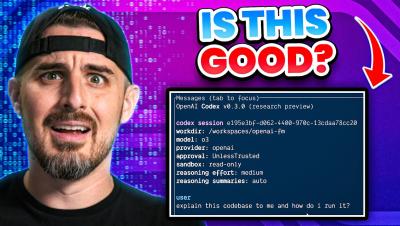
What We Found with OpenAI's Codex CLI Tool

In this video, I explore OpenAI’s Codex CLI tool to see how powerful it really is for coding with AI. But things quickly go off the rails… what started as a simple test ended with a surprise identity verification request. Apparently, to continue using the tool, I need to submit a government-issued ID and a photo of myself—something I didn’t expect at all. I talk through the process, show the error I ran into, and share my honest thoughts on this level of access and how invasive it feels for a developer tool.
Securing the Next Era: Why Agentic AI Demands a New Approach to API Security

I’ve spent my career building solutions to protect the API fabric that powers modern businesses. I founded Salt because I saw that traditional security tools such as WAFs, gateways, and CDNs weren’t designed to see or secure APIs. That gap led to breaches, blind spots, and billions in risk. Today, we’re facing a new wave of risk that’s even bigger than the last. The rise of Agentic AI has brought us to a true inflection point. Agentic AI isn’t just another software layer.

How Securonix is Reinventing MSSPs with AI and Scale - Mark Osmond Interview

Dive into how Securonix is revolutionizing the Managed Security Service Provider (MSSP) landscape with scalable partnerships, Unified Defense SIEM platforms, and advanced AI technologies. In this session, cybersecurity expert Mark Osmond, with 25+ years of industry experience, explores key MSSP challenges like cost management, scalability, and multi-tenancy—and how Securonix's Gartner-recognized, AWS-hosted SaaS platform is the solution.

LLMs Are Not Goldfish: Why AI Memory Poses a Risk to Your Sensitive Data

We’ve all heard the myth: goldfish have a memory span of just a few seconds. While that’s debatable in marine biology circles, it’s useful as a metaphor in tech, especially when talking about memory, risk, and AI. The problem is, large language models (LLMs) are not goldfish. In fact, they have incredible memory. And increasingly, that memory isn’t just session-based. It’s persistent, long-term, and system-connected. That changes everything.

Security is a Critical Factor in AI Adoption

Security is a Critical Factor in AI Adoption Jamison Utter joins A10's GenAI experts Madhav Aggarwal and Diptanshu Purwar to discuss the critical importance of security for AI adoption. They cover how AI fundamentally shifts the attack surface, requiring a move from traditional rule-based pattern matching to understanding natural language semantics. The team emphasizes the need for alignment in AI to ensure models are "helpful, harmless, and honest" (the 3H philosophy) and highlights the role of red teaming and guardrails in preventing vulnerabilities, such as prompt injection.

Securing AI-Generated Code: Why It Matters

Securing AI-Generated Code: Why It Matters In this video, A10's Madhav Aggarwal explains how using AI for coding is an excellent use case, but the code generated by AI must be safe and secure. As AI and large language models (LLMs) become central to enterprise strategy, securing these powerful workloads is no longer optional—it's essential. A10 Networks' security leaders, Jamison Utter, Madhav Aggarwal, and Diptanshu Purwar, explore the growing security risks associated with AI/LLM adoption and what organizations must do to stay protected.

What Is AI Penetration Testing? A Guide to Autonomous Security Testing

AI penetration testing is changing how organizations identify and exploit vulnerabilities. Instead of relying on traditional manual tests or basic automated scans, autonomous systems now simulate attacker behavior continuously and at scale. These systems use agentic AI to execute real-world exploits, reduce noise, and shift security left, all while keeping human experts focused on the creative flaws machines can’t yet catch.