Security | Threat Detection | Cyberattacks | DevSecOps | Compliance

The 12 Best Third-Party Risk Management Software Solutions (2026)

‍Last updated: August 20, 2026‍ A supplier breach or a tough question from a regulator can force a rushed third-party risk management (TPRM) evaluation. You need an answer before the next steering meeting. This list compares the 12 best third-party risk management tools in 2026, based on the capabilities that separate them in daily use, so you can shortlist faster. Whether you're an analyst running early research or a CISO approving the budget, you're working from the same criteria.

When Reading Apps Handle Sensitive Documents: A Practical Privacy Checklist

Read-aloud and AI explanation tools can make difficult material easier to use. Before opening a confidential PDF, however, users should understand where the text goes, what the app stores and which permissions it really needs.

Segmenting visibility with DNS Views for tighter network access control

Most organizations experience a strange DNS problem at some point: The same domain name means something different depending on who's asking for it. For example, a single internal app, workspace.company.com, might need to serve a locked-down instance to finance, a live staging build to engineering, and a stable production build to support — all under one domain and from the same DNS server.

Top tips: How to spot a scammer pretending to be your boss

Top tips is a weekly column where we highlight what's trending in the tech world and share practical ways to navigate these shifts. This week, we're looking at spear-phishing: how cybercriminals weaponize social engineering, why your natural instinct can act as a security blind spot, and practical steps to verify suspicious requests before you take action. I would like to make a confession: I’m a well-versed tech expert, but I almost fell for a phishing scam.

Quantifying OT Cyber Risk Without a Loss History

Quantifying cyber risk in an enterprise IT environment starts from frequency. Incidents of a given type happen at some rate, that rate is observable across enough organizations to be estimated, and severity follows from what was affected. ‍ Operational technology inverts both halves. Frequency data barely exists, and the consequences are already documented in detail by people who have never thought about cyber. Working with that inversion rather than against it is what makes the modeling tractable.

Decommissioning AI Agents: What to Look For in the Tooling

Gartner predicted in mid-2025 that more than forty percent of agentic AI projects would be canceled by the end of 2027, citing escalating costs, unclear business value and inadequate risk controls. Treat the figure as a forward-looking estimate rather than a measurement, since canceled projects tend to be quietly renamed, absorbed or left to lapse rather than formally closed. ‍

UEBA vs. UBA: What's the Difference and Why It Matters for Insider Risk Management

Organizations have invested heavily in technologies that detect suspicious activity. Yet insider incidents continue to rise, and security teams are often left to investigate isolated alerts without sufficient context to determine whether an event poses a meaningful risk. Behavioral analytics helps close that gap.

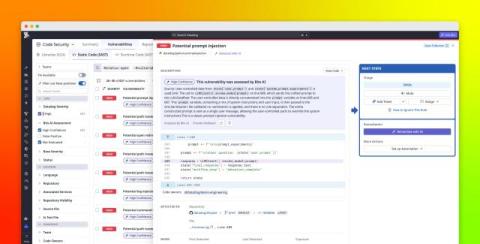
Detect vulnerabilities in LLM applications with Datadog's AI-native SAST

AI coding tools help developers build and deploy LLM applications quickly, but this speed comes with new security risks. Traditional static application security testing (SAST) tools that are pattern based weren’t designed to detect LLM-specific issues such as prompt injection sinks and exposed system prompts. These vulnerabilities often don’t become apparent until applications are already running in production, when remediation is more difficult and expensive.

From signals to systemic risk: Building Risk AI

Security and engineering teams contend with a constant stream of signals about vulnerabilities, incidents, misconfigurations, identity risks, control gaps, and other findings across their environments. But an individual finding’s severity does not always reflect its potential organizational impact.

What Is a Security Operations Center? a 2026 Guide

A security operations center is a centralized function that continuously monitors, detects, investigates, and responds to cyber threats across an organization's environment. The global SOC market was valued at USD 42.85 billion in 2024 in one estimate and is projected to reach USD 91.88 billion by 2034, while another estimate places it at USD 52.3 billion in 2025 with a projection of USD 130.2 billion by 2034 (market estimate).