Security | Threat Detection | Cyberattacks | DevSecOps | Compliance

The PAM blind spot: Where your AI agents are getting breached

Non-human identities (NHIs) are not new. We have run service accounts, scripts and machine credentials for years. What changed is the population. Every automation project and every AI investment adds more of them, and they now sit in the foreground of the security conversation, versus the background. You have probably seen the ratios in every deck on the topic. One hundred NHIs per human. Two hundred to one. Pick a number. The point in this session was that the exact ratio does not matter much anymore.

Threat Hunting to Detection Engineering, Part 2: Validating Rules Against Live Malware with Claude and LimaCharlie

Senior Solutions Engineer In Part 1, we looked at how to use Claude to analyze an unknown binary given a basic Linux system. Analysis is only half of the job, though, and while we can reasonably assume that our rules will work, especially for high-fidelity indicators such as hashes and IPs, rules looking for behaviors get more challenging to build and validate.

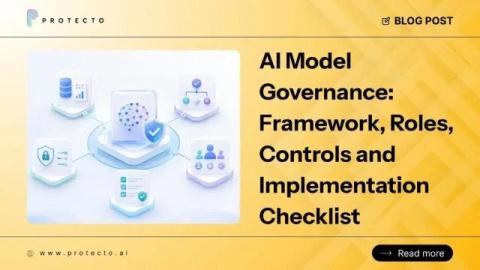
AI Model Governance: Framework, Roles, Controls and Implementation Checklist

AI models rarely become a governance problem because of the model alone. The real risk often emerges from what surrounds it: the data it receives, the decisions it influences, the systems it can access, and the people accountable for its outcomes. That makes AI model governance a lifecycle discipline, not simply a model approval process. Even NIST’s AI Risk Management Framework treats governance as a function that cuts across the entire AI lifecycle.

Prompt Injection Examples: 10 Real Attacks, and Which Ones Would Work on Your Agent

Prompt injection has not changed since 2022. What the model can do has. The instruction that hijacked a translation bot four years ago and the one that opened a homeowner’s windows last year are the same request: do something you are already allowed to do. The first system could only talk. The second could operate devices. Same sentence, different consequence. Here are ten real attacks, in order, and for each one the thing the system was allowed to do that made it work.

What Is Prompt Injection, Really? Why the Textbook Answer Cannot Tell You If You Have an Incident

Prompt injection is three things happening at once. The definition written in 2022 described a model that followed an instruction hidden in the text it was asked to translate. The definition needed in 2026 describes an agent that read a support ticket and then queried a customer table it had never touched, using a service account nobody had revoked. Those are the same attack.

How To Control Which WordPress Abilities an MCP Client/AI Agent Can Use

Connecting ChatGPT, Claude, or another AI agent to WordPress can turn simple instructions into real website actions. An agent can create posts, update pages, upload media, manage orders, and handle other tasks when the right MCP tools are available. The interesting part starts when you decide how much access to give it. A content management agent may need posts and media, while a WooCommerce support agent may need orders and customer information.


Respond to security threats faster with Tines and Observability Pipelines

Security teams face a flood of noisy logs that arrive in many formats, and often without the context teams need to detect and prioritize threats. But even normalized and contextually enriched log data is only as useful as the speed at which teams can act on it. Any step that requires manual effort can become a bottleneck that makes it difficult to keep pace with the volume.

To self-host or not to self-host your password manager

For an individual, self-hosting a password manager is rarely realistic. Most people don't run servers, handle patching, or manage uptime, so a cloud vault ends up being the only practical choice. For an organization, self-hosting becomes a real decision, one your security and IT teams can make deliberately. And once you can choose, you also take on the risks and the responsibility that come with that choice.

Introducing Adaptive Intelligence: Undermining the economics of every bot attack

Modern bot threats are increasingly driven by determined, sophisticated attackers. Often it is not even one person, but a group trading techniques with each other or a commercial service sold to anyone willing to pay. For many of them, getting past bot detection is a full-time job they genuinely enjoy. Block them and they get to work, finding a workaround. AI has simplified this further, making it even easier to set up complex configurations for attackers, lowering the overhead of an attack.