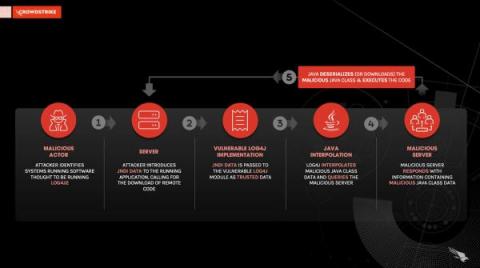
Note: This post first appeared in r/CrowdStrike. First and foremost: if you’re reading this post, I hope you’re doing well and have been able to achieve some semblance of balance between life and work. It has been, I think we can all agree, a wild December in cybersecurity (again). At this time, it’s very likely that you and your team are in the throes of hunting, assessing and patching implementations of Log4j2 in your environment.
The last week has been a wild ride for just about everyone in the technology world due to the public disclosure of the Log4Shell vulnerability. As a developer security company, Snyk has built our business around proactive automation to identify and fix security issues in applications. To say we’ve been busy this week would be an understatement.
The notorious Log4Shell vulnerability CVE-2021-45046, has put Log4j in the spotlight, and grabbed the entire Java community’s attention over the last couple of weeks. Maintainers of Java projects that use Log4j have most probably addressed the issue. Meanwhile, non-java developers are enjoying relative peace of mind, knowing that they are unaffected by one of the major vulnerabilities found in recent years. Unfortunately, this is an incorrect assumption.
If you have access to the internet, it’s likely that you have already heard of the critical vulnerability in the Log4j library. A zero-day vulnerability in the Java library Log4j, with the assigned CVE code of CVE-2021-44228, has been disclosed by Chen Zhaojun, a security researcher in the Alibaba Cloud Security team. It’s got people worried—and with good reason.
The recently discovered Log4j vulnerability has serious potential to expose organizations across the globe to a new wave of cybersecurity risks as threat actors look to exploit this latest vulnerability to execute their malicious payloads using remote code execution (RCE). An immediate challenge that every organization faces is simply trying to understand exactly where you have applications that are using this very popular Java library — but you are not facing this challenge alone.
Ever since the public exploit of the Log4Shell remote code execution (RCE) vulnerability became known on December 10, 2021, security teams have been scrambling to understand the risk to their environments. Part of that scramble has been to ascertain which tools are best positioned to help detect the vulnerability. Which approaches are most effective and where do they fall short?
The world of cybersecurity has been constantly challenged since the pandemic started. With the dust still settling, a new concern has taken the entire cyber landscape by storm. A flaw in Log4j, a widely used Java-based logging library, allows hackers unbridled access to computer systems. The vulnerability (CVE-2021-44228) affects everything from the cloud to security devices. Attackers have come up with worms that can spread independently from one vulnerable system to another.
The situation involving the log4j ( log4shell ) vulnerability has been rapidly evolving since its release a little over a week ago. A new exploit, CVE-2021-45046, was found which was not covered by the initial 2.15.0 patch. Not long after the 2.16.0 patch was released, another issue was found, CVE-2021-45105, which resulted in the release of 2.17.0. There is clearly a lot going on in the log4j library.