Security | Threat Detection | Cyberattacks | DevSecOps | Compliance

The Legitimate Bot Traffic Security Teams Can No Longer Overlook

Security teams have spent years refining their ability to detect and stop malicious bots. That work remains critical. Automated traffic now accounts for more than half of all web traffic, according to Imperva's 2025 Bad Bot Report. What has changed is the scale and influence of legitimate bots and the blind spots they introduce into modern security programs.

Exabeam Introduces First Connected System for AI Agent Behavior Analytics and AI Security Posture Insight

Industry leadership expanded with connected capabilities that not only uncover AI agent activity, but centralize investigation, and deliver measurable AI security posture insights.

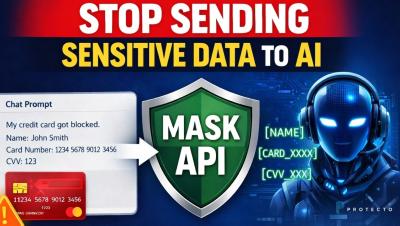
Secrets in the Machine: Preventing Sensitive Data Leaks Through LLM APIs

In this webinar, we break down a simple but increasingly common problem: secrets leak wherever text flows, and modern LLM apps and agentic workflows are built to move text fast. We walk through concrete demos showing how API keys and passwords can surface through RAG-based assistants when secrets accidentally live in knowledge bases (tickets, docs, internal wikis). We also show why “just harden the system prompt” isn’t a reliable fix, and how output-only redaction can be bypassed (for example by simple formatting/encoding tricks). Most importantly, we explore real-world agent architectures.

Agentic AI Security: How Microsoft Prevents Autonomous Agent Attacks?

As agentic AI systems move into the mainstream—powered by tool calling, MCP, and autonomous workflows—security is no longer a “nice to have.” It’s mission-critical. In this episode, we sit down with Raji, Principal Engineer & Manager for AI and Safety at Microsoft, to deep-dive into the rapidly evolving world of AI security, autonomous agents, and enterprise governance. Discover how Microsoft identifies and mitigates risks in agentic AI, distinguishes AI Security vs AI Safety, and enables organizations to deploy autonomous systems safely at scale—without slowing innovation.

Will AI agents 'get real' in 2026?

In my house, we consume a lot of AI research. We also watch a lot—probably too much—TV. Late in 2025, those worlds collided when the AI giant Anthropic was featured on “60 Minutes.” My husband tried to scroll past it, but I snatched the controller away, unable to resist a headline calling out the first widely acknowledged case of an “agentic AI cyberattack.” The framing itself was irresistible, a milestone moment in the rapid acceleration of AI.

Model Context Protocol Server: The Universal Remote for AI Agents

The Model Context Protocol (MCP) is emerging as a foundational interoperability layer for agentic AI, embraced by major platform providers. MCP simplifies how AI models connect to external tools and data. Think of it as a universal remote for security platforms: Instead of building fragile, one-off integrations, MCP allows AI to discover and use capabilities dynamically. For SIEM and detection providers, this shift is significant.

The Silent Threat to the Agentic Enterprise: Why BOLA is the #1 Risk for AI Agents

In the race to deploy autonomous AI agents, organizations are inadvertently building on a foundation of shifting sand. While security teams have spent the last year focused on "Prompt Injection" and "Model Poisoning," a much older, more dangerous adversary has quietly become the primary attack vector for the agentic era: Broken Object Level Authorization (BOLA).

Why AI security looks different across the UK, France, Germany, and Australia

Globally, 88% of companies regularly use AI in at least one business function—a 10% increase from the previous year. But as organizations race to adopt new capabilities, we’ve found that the rigor and maturity of AI governance vary widely by region. ‍ The third edition of our State of Trust report reveals how leading AI adopters outside the U.S.—from the UK to Germany, France, and Australia—are approaching AI security and governance in distinct ways.