Security | Threat Detection | Cyberattacks | DevSecOps | Compliance

How To Discover PII and Privacy Vulnerabilities in Structured Data Sources

In this video, we walk through the process of discovering personally identifiable information (PII) and identifying potential privacy vulnerabilities within structured data sources. First, you will connect Protecto to your data repository. Then, we will show you how to access the Privacy Risk Data within your data assets catalog, obtain information on active users, access privileges, data owners, and recommendations for dealing with privacy risks.


Demystifying NIST Vulnerability Management: A Comprehensive Guide

Protecting sensitive information and securing digital assets now require the use of cybersecurity. Organizations must employ proactive steps to spot and address vulnerabilities as cyber threats continue to become more complex and sophisticated. Vulnerability assessment is one such method, which is important in cybersecurity risk management.

The most common vulnerabilities in your external attack surface

Imagine your organization’s digital fortress – now picture a thousand hidden doors, each a potential entry point for cyber threats. In the world of cybersecurity, these doors are known as ‘external attack surface vulnerabilities’ and understanding them is the first step to locking them down. External attack surface vulnerabilities are the weak points of a company’s network that can potentially be exploited by malicious actors.

How to avoid web cache poisoning attacks

Web cache poisoning is a cyber attack that wreaks havoc on unsuspecting websites. It exploits vulnerabilities by caching mechanisms that web servers, proxies, and content delivery networks (CDNs) use, compromising data integrity. Malicious actors can use cache poisoning to deliver malicious payloads, tamper with sensitive information, or redirect users to fraudulent websites. In this article, we’ll comprehensively explore web cache poisoning attacks and how they work.

Cisco VPN Zero-Day exploited by ransomware gangs (CVE-2023-20269) - Insights and best practices for defense

In the tech security scene, we’re always on the lookout for new vulnerabilities, especially when they are already exploited in the wild. The latest zero-day CVE-2023-20269 is hitting Cisco’s Adaptive Security Appliance VPN features. The attack surface scan conducted by IONIX research on a sample of organizations indicates that 13% of these appliances are potentially vulnerable through at least one interface.

Real-World Security Testing: Uncovering Vulnerabilities in Uninterrupted Power Supplies

Think your organization's security is rock-solid? It's time to put it to the real-world test! In this eye-opening video, we share a fascinating story of a security assessment that revealed some shocking vulnerabilities. When a company claimed to have a secure environment, they decided to take it a step further and put their confidence to the test. They asked, "Are you sure you want this real-world?" And the answer was a resounding "Yes!".

2023 OWASP Top-10 Series: API7:2023 Server Side Request Forgery

Welcome to the 8th post in our weekly series on the new 2023 OWASP API Security Top-10 list, with a particular focus on security practitioners. This post will focus on API7:2023 Server Side Request Forgery (SSRF). In this series we are taking an in-depth look at each category – the details, the impact and what you can do about it.

Contextual Analysis for Python, Java, and JavaScript Projects with JFrog Frogbot

When scanning packages, CVE (Common Vulnerabilities and Exposures) scanners can find thousands of vulnerabilities. This leaves developers with the painstaking task of sifting through long lists of vulnerabilities to identify the relevance of each, only to find that many vulnerabilities don’t affect their artifacts at all.

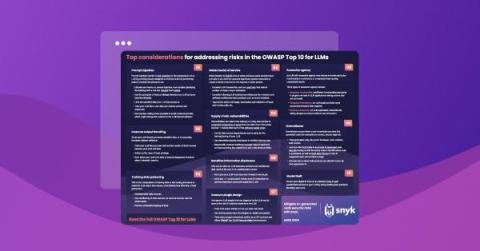
Top considerations for addressing risks in the OWASP Top 10 for LLMs

Welcome to our cheat sheet covering the OWASP Top 10 for LLMs. If you haven’t heard of the OWASP Top 10 before, it’s probably most well known for its web application security edition. The OWASP Top 10 is a widely recognized and influential document published by OWASP focused on improving the security of software and web applications. OWASP has created other top 10 lists (Snyk has some too, as well as a hands-on learning path), most notably for web applications.

New Container Exploit: Rooting Non-Root Containers with CVE-2023-2640 and CVE-2023-32629, aka GameOver(lay)

Two new local privilege escalation vulnerabilities were recently discovered in Ubuntu: CVE-2023-2640 (CVSS 7.8) and CVE-2023-32629 (CVSS 7.8). The vulnerabilities, dubbed GameOver(lay), affect the OverlayFS module in multiple Ubuntu kernels. Ubuntu’s official security bulletin here and here outlines the impacted versions by both CVEs. It’s important to note that CrowdStrike Falcon® Cloud Security protects against both vulnerabilities.