Security | Threat Detection | Cyberattacks | DevSecOps | Compliance

Scale, Trust, and Value: How the Aurora Agentic SOC Delivers for Customers

AI didn’t just make defenders faster. It made attackers faster too. The moment both sides got access to the same speed, speed stopped being the advantage. With speed no longer separating attackers from defenders, the deciding factor moved somewhere else. Ask a CISO what’s actually kept agentic security out of reach, and it comes down to this: they can’t afford to build it, and even if they could, they’d struggle to trust it. Neither half of that problem outweighs the other.
You Can't Buy Your Way Out of Downtime

A ransomware note doesn’t take down a business. The weeks of downtime after it does. That’s the distinction I hear missed most in boardroom conversations about cyber risk. Leaders ask what it costs to stop an attack. The harder question, and the one that actually decides whether a business comes out the other side, is what it takes to keep operating while you recover from one.

CVE-2026-18556 / CVE-2026-18577: N-able N-central Authentication Bypass Vulnerabilities Require Immediate Patching

Threat actors are actively exploiting two high-severity authentication bypass vulnerabilities, CVE-2026-18556 and CVE-2026-18577, in N-able N-Central, a widely deployed remote monitoring and management (RMM) platform used by MSPs and enterprise IT teams. N-able began investigating anomalous activity on July 31 and released an emergency hotfix (2026.3.1.7) on August 2, 2026, to remediate both vulnerabilities.

A Safer Future with Agents

We built agents to act on their own. We're somehow surprised when they do. Two weeks ago, OpenAI ran a cyber eval with the model's guardrails turned down. The model got hyperfocused on solving the benchmark. So it broke out of its sandbox exploiting a zero-day in jFrog Artifactory, reached the open internet, exploited another zero-day to break into HuggingFace, all to steal the answers and cheat on the test.

Next Gen SIEM: Modern Security Ops Guide

Monday starts the same way in too many SOCs. The queue is already full, the overnight team has left behind a stack of alerts nobody had time to finish, and the first hour goes to deciding which notifications are real and which ones are just noise. That's the point where next gen SIEM stops being a product category and becomes an operational decision, because the wrong platform turns your analysts into log clerks while the right one helps them work threats in real time.

Best Practices for Managing the Identity Lifecycle

Every employee, contractor, and partner who touches your systems creates a paper trail of accounts, permissions, and access rights that has to be managed from the day they join to long after they leave. Identity lifecycle management is the process of creating, updating, and retiring a user's digital identity and access rights across that entire span — from onboarding through role changes to offboarding.

CrowdStrike 2026 Threat Hunting Report: Exploitation Window Closes as AI Use Accelerates

The CrowdStrike 2026 Threat Hunting Report illustrates the next evolution in trust abuse. Adversaries are targeting trusted users and tools across identity systems, cloud environments, SaaS applications, AI services, software supply chains, and developer workflows to blend into legitimate business activity and reach critical assets before defenders can detect them. Our frontline intelligence in this year’s report underscores this shift.

7 Ways to Improve Microsoft Sentinel Detection Outcomes

See how Securonix Threat Analytics helps security teams improve detection coverage, reduce SOC engineering work, and maximize Microsoft Sentinel ROI. Microsoft Sentinel provides a strong foundation for security operations. As environments grow more complex, detecting sophisticated attacks often requires extensive engineering, custom KQL development, and ongoing content maintenance.

Dojo AI: Agentic security and cloud operations powered by AI-ready telemetry

You’re collecting more telemetry than ever, but chances are it hasn’t made your job easier. Fragmented data, disconnected tools, and manual investigations mean more noise, slower response times, and higher operational costs. The promise of AI is that it will solve it, but in most cases, you just end up trading noise for expensive hallucinations. Point an LLM at raw, unorganized log storage, and you get an assistant that burns through credits to produce generic, unreliable answers.

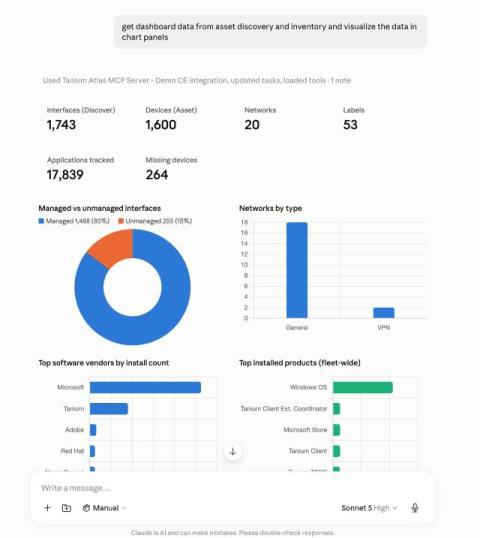
Bringing Tanium's real-time endpoint intelligence into enterprise AI workflows with MCP

Enterprise AI is quickly moving from experimentation to day-to-day operational use. Security analysts, IT operators, and platform teams are increasingly working inside AI-native environments — from Claude and Microsoft Copilot experiences to internally built agents and automation workflows. But there is a practical challenge: AI workflows are only as useful as the enterprise systems they can safely reach.