Security | Threat Detection | Cyberattacks | DevSecOps | Compliance

Quantifying OT Cyber Risk Without a Loss History

Quantifying cyber risk in an enterprise IT environment starts from frequency. Incidents of a given type happen at some rate, that rate is observable across enough organizations to be estimated, and severity follows from what was affected. ‍ Operational technology inverts both halves. Frequency data barely exists, and the consequences are already documented in detail by people who have never thought about cyber. Working with that inversion rather than against it is what makes the modeling tractable.

Decommissioning AI Agents: What to Look For in the Tooling

Gartner predicted in mid-2025 that more than forty percent of agentic AI projects would be canceled by the end of 2027, citing escalating costs, unclear business value and inadequate risk controls. Treat the figure as a forward-looking estimate rather than a measurement, since canceled projects tend to be quietly renamed, absorbed or left to lapse rather than formally closed. ‍

UEBA vs. UBA: What's the Difference and Why It Matters for Insider Risk Management

Organizations have invested heavily in technologies that detect suspicious activity. Yet insider incidents continue to rise, and security teams are often left to investigate isolated alerts without sufficient context to determine whether an event poses a meaningful risk. Behavioral analytics helps close that gap.

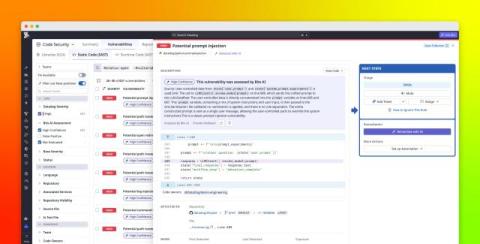
Detect vulnerabilities in LLM applications with Datadog's AI-native SAST

AI coding tools help developers build and deploy LLM applications quickly, but this speed comes with new security risks. Traditional static application security testing (SAST) tools that are pattern based weren’t designed to detect LLM-specific issues such as prompt injection sinks and exposed system prompts. These vulnerabilities often don’t become apparent until applications are already running in production, when remediation is more difficult and expensive.

From signals to systemic risk: Building Risk AI

Security and engineering teams contend with a constant stream of signals about vulnerabilities, incidents, misconfigurations, identity risks, control gaps, and other findings across their environments. But an individual finding’s severity does not always reflect its potential organizational impact.

CrowdStrike Named Strongest Overall Leader in 2026 Frost Radar: Cloud Workload Protection Platforms

We are proud to announce that Frost & Sullivan has named CrowdStrike as the strongest overall leader in the Frost Radar: Cloud Workload Protection Platforms, 2026. CrowdStrike earned the highest scores in Innovation and Growth among 18 companies benchmarked from a field of more than 45 qualified participants. Today’s cloud attacks are designed to hide in plain sight.

What Is a Security Operations Center? a 2026 Guide

A security operations center is a centralized function that continuously monitors, detects, investigates, and responds to cyber threats across an organization's environment. The global SOC market was valued at USD 42.85 billion in 2024 in one estimate and is projected to reach USD 91.88 billion by 2034, while another estimate places it at USD 52.3 billion in 2025 with a projection of USD 130.2 billion by 2034 (market estimate).

Give your agents capabilities

Accelerating security solutions for small businesses‍ Tagore offers strategic services to small businesses. A partnership that can scale‍ Tagore prioritized finding a managed compliance partner with an established product, dedicated support team, and rapid release rate. Standing out from competitors‍ Tagore's partnership with Vanta enhances its strategic focus and deepens client value, creating differentiation in a competitive market.

The Hidden Costs of On-Prem Infrastructure

One of the more underreported consequences of the artificial intelligence (AI) boom has been its impact on conventional enterprise infrastructure. For years, IT executives could rely on a relatively predictable rhythm of hardware purchases, refresh cycles, and procurement lead times. On-premises infrastructure was never effortless to manage, but its patterns were, at the very least, well-established.