Security | Threat Detection | Cyberattacks | DevSecOps | Compliance

Introducing new Vanta capabilities to automatically improve your security posture

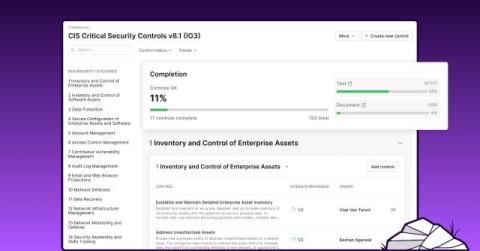
From day one, Vanta has helped security teams build and maintain a strong security posture to protect sensitive data and reduce business risk. Our industry-leading trust management platform provides automated, continuous compliance, ensuring that the necessary people, processes, and technology for strong security are in place and working effectively. ‍ With Vanta, customers like Unleash and Pigment are able to reduce costs and free up resources for strategic security initiatives.


What's new in Tines: July 2024 Edition

Have you thought about how you can keep your Tines stories short and efficient? Use rules in your Webhook Action to create events based on specific requests. Events are only created when a rule is matched. When you want to focus on a specific result, customize response action options or filter out requests with regex that do not match your criteria.

Advanced Network Device Scanning Techniques with Total Network Inventory (TNI)

In network management, the ability to efficiently scan network for devices is crucial for maintaining security, optimizing performance, and ensuring effective asset management. Total Network Inventory (TNI) offers a range of methods to scan network devices.

10 Testing Techniques Every UX/UI Designer Should Know

When designing digital products like websites, applications, software, and the like, one of the most crucial factors to take into account is user experience (UX) and user interface (UI) design. To ensure that their products are user-friendly and satisfy the needs of their intended audience, designers employ testing strategies during the design process. If you're new to the designing process or even have some experience, these ten testing techniques will help you enhance your design process.

Improve security with instant feedback: how policies with notifications educate users

Real-time feedback on risky behavior stops sensitive data exfiltration and educates employees on security best practices, based on research from Cyberhaven Labs analyzing data on warning and blocking policy implementations.

Next-Gen Vulnerability Assessment: AWS Bedrock Claude in CVE Data Classification

Large language models are fascinating tools for cybersecurity. They can analyze large quantities of text and are excellent for data extraction. One application is researching and analyzing vulnerability data, specifically Common Vulnerabilities and Exposures (CVE) information. As an application security company with roots in open source software vulnerability detection and remediation, the research team at Mend.io found this a particularly relevant area of exploration.

Malicious Inauthentic Falcon Crash Reporter Installer Delivers LLVM-Based Mythic C2 Agent Named Ciro

On July 24, 2024, an unattributed threat actor distributed a password-protected installer masquerading as an inauthentic Falcon Crash Reporter Installer to a German entity in an unattributed spear-phishing attempt. Subsequent analysis revealed that executing the installer with the threat actor-provided password leads to a novel execution chain in which an agent written to the Mythic command-and-control (C2)1 framework is executed as LLVM Intermediate Representation (IR) bitcode.

Java, JavaScript, .NET: Which Has the Riskiest Security Debt?

In the realm of secure software development, managing security debt is crucial. The following data highlights a concerning trend in the accumulation of critical security debt, particularly in the popular programming languages of Java, JavaScript, and.NET. Let’s dive into this new research and explore options for managing the prioritization dilemma we’re seeing.

How to setup PGP Keys for Encrypted Email

In today's world, electronic mails (e-mails) serve as a medium of both official and personal correspondence. With sensitive information being shared online, it's essential to secure your emails. Pretty Good Privacy (PGP), a robust encryption program, offers a reliable solution for securing the contents of your emails. Developed by Phil Zimmermann in 1991, PGP utilizes public-key cryptography to ensure both confidentiality and authenticity in email exchanges.

Multiple Cross-Site Scripting (XSS) Vulnerabilities in REDCap (CVE-2024-37394, CVE-2024-37395, and CVE-2024-37396)

Trustwave SpiderLabs uncovered multiple stored cross-site scripting (XSS) vulnerabilities (CVE-2024-37394, CVE-2024-37395, and CVE-2024-37396) in REDCap (Research Electronic Data Capture), a widely used web application for building and managing online surveys and databases in research environments. These vulnerabilities, if exploited, could allow attackers to execute malicious JavaScript code in victims' browsers, potentially compromising sensitive data.