Today, AWS announced the general availability of Amazon ECS Exec, a powerful feature to allow developers to run commands inside their ECS containers. Amazon Elastic Container Service (ECS) is a fully managed container orchestration service by Amazon Web Services. ECS allows you to organize and operate container resources on the AWS cloud, and allows you to mix Amazon EC2 and AWS Fargate workloads for high scalability.
CVE-2020-13942 is a critical vulnerability that affects the Apache open source application Unomi, and allows a remote attacker to execute arbitrary code. In the versions prior to 1.5.1, Apache Unomi allowed remote attackers to send malicious requests with MVEL and OGNL expressions that could contain arbitrary code, resulting in Remote Code Execution (RCE) with the privileges of the Unomi application.
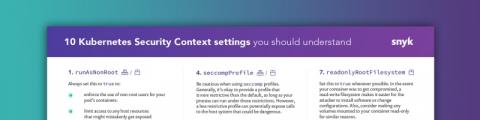
Securely running workloads in Kubernetes can be difficult. Many different settings impact security throughout the Kubernetes API, requiring significant knowledge to implement correctly. One of the most powerful tools Kubernetes provides in this area are the securityContext settings that every Pod and Container manifest can leverage. In this cheatsheet, we will take a look at the various securityContext settings, explore what they mean and how you should use them.
The privilege escalation category inside MITRE ATT&CK covers quite a few techniques an adversary can use to escalate privileges inside a system. Familiarizing yourself with these techniques will help secure your infrastructure. MITRE ATT&CK is a comprehensive knowledge base that analyzes all of the tactics, techniques, and procedures (TTPs) that advanced threat actors could possibly use in their attacks.
Today, I’m excited to announce the contribution of the sysdig kernel module, eBPF probe, and libraries to the Cloud Native Computing Foundation. The source code of these components will move into the Falco organization and be hosted in the falcosecurity github repository. These components are at the base of Falco, the CNCF tool for runtime security and de facto standard for threat detection in the cloud.
Image vulnerability scanning is a critical first line of defense for security with containers and Kubernetes. Today, Red Hat recognized Sysdig as a certified Red Hat security partner based on our work to standardize on Red Hat’s published security data with Sysdig Secure.
So, you want to build a Java application and run it inside a Docker image? Wouldn’t it be awesome if you knew what best practices to follow when building a Java container with Docker? Let me help you out with this one! In the following cheatsheet, I will provide you with best practices to build a production-grade Java container. In the Java container example, I build using these guidelines, I will focus on creating an optimized secure Java container for your application.