Security | Threat Detection | Cyberattacks | DevSecOps | Compliance

Protecting Against the Unpatched Kubernetes Vulnerability (CVE-2020-8554)

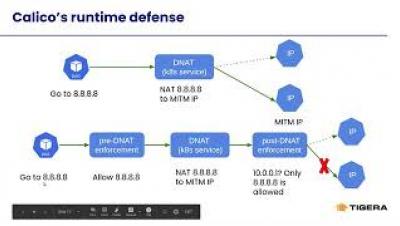
CVE-2020-8554 is a vulnerability that allows Kubernetes Services to intercept cluster traffic to any IP address. Users who can manage services can exploit the vulnerability to carry out man-in-the-middle (MITM) attacks against pods and nodes in the cluster. All Kubernetes versions including the latest release (v1.20) are vulnerable to this attack. If your cluster is multi-tenant, or allows unprivileged users to create and update services, you are impacted.

Calico Enterprise Multi Cluster Management - Federated Identity and Services

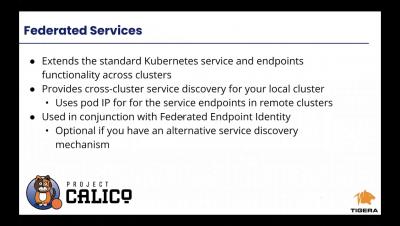
Managing multiple Kubernetes clusters can become time consuming and complex. Calico Enterprise can help with built in multi-cluster management capabilities to simplify deployment and ongoing operations, including securing interactions between the clusters, and providing cross-cluster service discovery.

Snyk and Rapid7 strengthen partnership to provide a holistic risk assessment solution for container applications

Modern organizations are working hard to differentiate their products and services by creating innovative solutions that their customers can leverage at home and on-the-go, forcing them to consider new, more agile approaches to application development that empower their development teams to accelerate time-to-market, and launch new solutions as quickly as possible.

TeamTNT delivers malware with new detection evasion tool

AT&T Alien Labs™ has identified a new tool from the TeamTNT adversary group, which has been previously observed targeting exposed Docker infrastructure for cryptocurrency mining purposes and credential theft. The group is using a new detection evasion tool, copied from open source repositories. The purpose of this blog is to share new technical intelligence and provide detection and analysis options for defenders.

Docker for Node.js developers: 5 things you need to know not to fail your security

Docker is totalling up to over 50 billion downloads of container images. With millions of applications available on Docker Hub, container-based applications are popular and make an easy way to consume and publish applications. That being said, the naive way of building your own Docker Node.js web applications may come with many security risks. So, how do we make security an essential part of Docker for Node.js developers?

Microservices, Containers and Kubernetes in 10 minutes

What is a microservice? Should you be using microservices? How are microservices related to containers and Kubernetes? If these things keep coming up in your day-to-day and you need an overview in 10 minutes, this blog post is for you. Fundamentally, a microservice is just a computer program which runs on a server or a virtual computing instance and responds to network requests.

Enterprise Security Controls for Kubernetes

In this talk, we will explore how to meet common enterprise security control needs when running Kubernetes. We will look at a range of common enterprise security needs and how you can meet these with standard Kubernetes primitives and open source projects such as Calico, or take it a step further with the additional features of Calico Enterprise.

Falco vs. AuditD from the HIDS perspective

In this blog, we will compare and contrast Falco vs. AuditD from a Host Intrusion Detection (HIDS) perspective. AuditD is a native feature to the Linux kernel that collects certain types of system activity to facilitate incident investigation. Falco is the CNCF open-source project for runtime threat detection for containers and Kubernetes. We will dig deeper into the technical details and cover the installation, detection, resource consumption, and integration between both products.

Security context: The starting point for how Kubernetes Pod security works

Organizations are increasingly adopting Kubernetes to manage their containerized workloads and services, but Kubernetes security incidents are on the rise, as well. In the fall 2020 edition of the “State of Container and Kubernetes Security” report, for instance, 91% of respondents told StackRox that they had recently adopted Kubernetes. Three quarters of survey participants went on to reveal that they had deployed the container orchestration platform in their production environments.