Security | Threat Detection | Cyberattacks | DevSecOps | Compliance

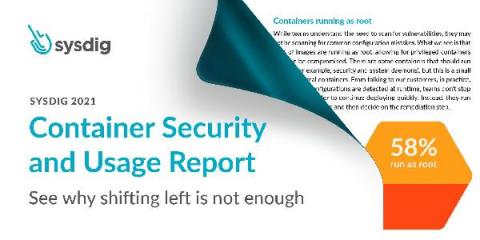
Sysdig 2021 container security and usage report: Shifting left is not enough

The fourth annual Sysdig container security and usage report looks at how global Sysdig customers of all sizes and industries are using and securing container environments. By examining how and when organizations are implementing security in the development lifecycle, we have been able to uncover some interesting data points in this year’s report. For example, we can see that 74% of organizations are scanning container images in the build process.

Runtime Threat Detection on AWS

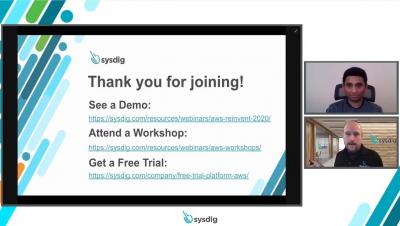
Join Sysdig and AWS experts to learn how to detect and respond to threats to your production applications running on services like AWS Fargate and Amazon EKS. With the rise of microservices and DevOps practices, new security threats put your infrastructure and applications at risk. Hear how to leverage signals from AWS CloudTrail and open source Falco to spot unexpected behavior, block threats, and validate compliance across your AWS environment.

Runtime Threat Detection on AWS

Tune into our #LinkedInLive event on Jan 12 at 10 am PST and Join Sysdig and AWS experts to learn how to detect and respond to threats to your production applications running on services like AWS Fargate and Amazon EKS. With the rise of microservices and DevOps practices, new security threats put your infrastructure and applications at risk. Hear how to leverage signals from AWS CloudTrail and open source Falco to spot unexpected behavior, block threats, and validate compliance across your AWS environment.

Stackrox Acquisition: The Race to Secure Containers

Today, Red Hat announced its intent to acquire Stackrox. This is a very exciting development in the world of cloud-native security! First and foremost, congratulations to Stackrox, an early participant in the container security space. This acquisition is a great outcome for Stackrox given their nascent scale and on-premises offering.

5 Best practices for ensuring secure container images

Most modern organizations understand that the earlier you integrate security into the development process, the more secure the applications will be in production. For containerized workloads, securing the container image throughout the application life cycle is a critical part of security, but many organizations don’t even follow basic best practices for ensuring secure container images.

Key Kubernetes audit logs for monitoring cluster security

Kubernetes continues to be a popular platform for deploying containerized applications, but securing Kubernetes environments as you scale up is challenging. Each new container increases your application’s attack surface, or the number of potential entry points for unauthorized access. Without complete visibility into every managed container and application request, you can easily overlook gaps in your application’s security as well as malicious activity.

Detect CVE-2020-8554 using Falco

CVE-2020-8554 is a vulnerability that particularly affects multi-tenant Kubernetes clusters. If a potential attacker can create or edit services and pods, then they may be able to intercept traffic from other pods or nodes in the cluster. An attacker that is able to create a ClusterIP service and set the spec.externalIPs field can intercept traffic to that IP. In addition, an attacker that can patch the status of a LoadBalancer service can set the status.loadBalancer.ingress.ip to similar effect.

New Vulnerability Exposes Kubernetes to Man-in-the-Middle Attacks: How to Mitigate CVE-2020-8554

A few weeks ago a solution engineer discovered a critical flaw in Kubernetes architecture and design, and announced that a “security issue was discovered with Kubernetes affecting multi-tenant clusters. If a potential attacker can already create or edit services and pods, then they may be able to intercept traffic from other pods (or nodes) in the cluster.” If a hostile user can create a ClusterIP service and set the spec.externalIP field, they can intercept traffic to that IP.

Data Protection in the Age of Cloud Native Applications with CloudCasa - Part 3

In part 1 of this blog series on data protection for Kubernetes and cloud native applications, we addressed the need for Data Protection for Containerized Applications. Given that the leading Kubernetes distributions and managed cloud services do not include native capabilities for data protection and disaster recovery, service providers and enterprises need additional data management tools such as CloudCasa to provide these.

Enabling Secure Kubernetes Multi-Tenancy with Calico Enterprise

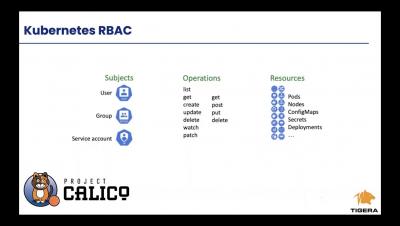
When you have different teams interacting with a Kubernetes cluster you need to think about the security, privacy, and observability challenges associated with multi-tenancy: How to provide each team with access to the specific resources they need, in a way that allows the team to be agile, without risking impacting other teams? In this session, we’ll explore the Kubernetes multi tenancy concepts and design patterns needed for successful enablement of multi-tenancy within your Kubernetes clusters using key capabilities of Calico Enterprise.