Security | Threat Detection | Cyberattacks | DevSecOps | Compliance

CrowdStrike Identifies New Kiss-a-Dog Cryptojacking Campaign Targeting Vulnerable Docker and Kubernetes Infrastructure

CrowdStrike has identified a new cryptojacking campaign targeting vulnerable Docker and Kubernetes infrastructure. Called “Kiss-a-dog,” the campaign targets Docker and Kubernetes infrastructure using an obscure domain from the payload, container escape attempt and anonymized “dog” mining pools.
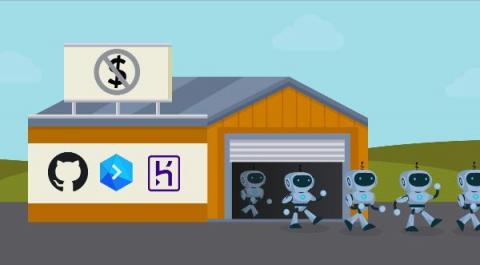
Sysdig TRT uncovers massive cryptomining operation leveraging GitHub Actions

The Sysdig Threat Research Team (Sysdig TRT) recently uncovered an extensive and sophisticated active cryptomining operation in which a threat actor is using some of the largest cloud and continuous integration and deployment (CI/CD) service providers; including GitHub, Heroku, Buddy.works, and others to build, run, scale, and operate their massive cloud operation. Because no one has yet reported on this activity and its techniques, we are going to refer to this cluster of activity as PURPLEURCHIN.

Zero trust in the cloud: Best practices and potential pitfalls

Architecturally speaking, cloud-native applications are broken down into smaller components that are highly dynamic, distributed, and ephemeral. Because each of these components is communicating with other components inside or outside the cluster, this architecture introduces new attack vectors that are difficult to protect against using a traditional perimeter-based approach.

How to validate Kubernetes YAML files?

Kubernetes has taken center stage in how we now manage our containerized applications. As a result, many conventions to define our Kubernetes apps exist, including structures such as YAML, JSON, INI, and more. This leaves us to consider what is the best strategy to follow for our applications. Additionally, we must then also ask how we can validate our application configurations depending on the path we’ve chosen in terms of file structure and especially security.

Detecting and mitigating CVE-2022-42889 a.k.a. Text4shell

A new critical vulnerability CVE-2022-42889 a.k.a Text4shell, similar to the old Spring4shell and log4shell, was originally reported by Alvaro Muñoz on the very popular Apache Commons Text library. The vulnerability is rated as a critical 9.8 severity and it is always a remote code execution (RCE) which would permit attackers to execute arbitrary code on the machine and compromise the entire host.

JFrog Advanced Security

Introducing JFrog Advanced Security, the world’s first DevOps-centric security solution designed to control and protect your software supply chain from code to containers to production. As part of JFrog Xray and integrated into the universal JFrog DevOps Platform, these security features focus at the binary level, revealing issues that are not visible in source code alone. These new features go beyond the traditional software composition analysis (SCA) capabilities of JFrog Xray, with a focus on container security.

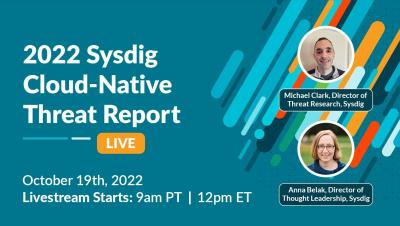
Sysdig Talks 2022 Threat Landscape (Live)

Is your organization ready to pay an additional $430,000 cloud bill as a result of cryptojacking? The Sysdig Threat Research Team recently released the 2022 Sysdig Cloud-Native Threat Report, which details the cost of cryptojacking, the reality of software supply chain risks, and how hacktivism has become a prominent feature in cyber warfare. While the motives of hackers have not changed, they have adjusted their attack patterns and tactics to penetrate cloud environments more effectively. Fortify your cloud by understanding the current threat landscape and identifying defense strategies.

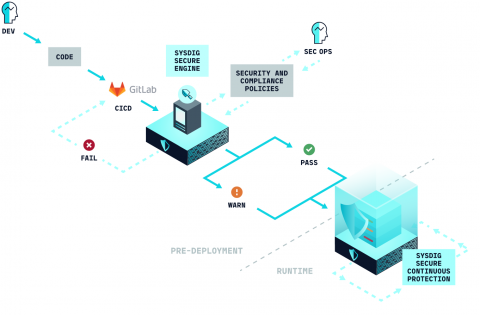
Image scanning for GitLab CI/CD

Scanning a container image for vulnerabilities or misconfigurations on your GitLab CI/CD using Sysdig Secure is a straightforward process. This article demonstrates a step-by-step example of how to do it. The following proof of content showcased how to leverage the sysdig-cli-scanner with GitLab CI/CD. Although possible, this procedure is not officially supported by Sysdig, so we recommend checking the documentation to adapt these steps to your environment.

Secure your application from Argo CD to Kubernetes

GitOps is a popular framework for managing and securing the application development pipeline. For many who have embarked on a GitOps journey, a common question is: “how can I secure my pipeline when everything is automated?” The GitOps framework is a concept where any code commits or changes are done through Git, which then triggers an automated pipeline that builds and deploys applications on Kubernetes.