Learn how to back up a Proxmox VE VM to tape using a backup copy job, and how to recover a Proxmox VE VM directly from tape to a Proxmox host with NAKIVO Backup & Replication. Learn more.
Infrastructure as a service (IaaS) is becoming a bigger opportunity for managed service providers (MSPs), cloud service providers (CSPs), hosters and telecommunications providers. Clients still need compute, storage and networking. But many are rethinking where those workloads should run.
Learn how to convert a physical Linux machine to a Hyper-V virtual machine using a backup with NAKIVO Backup & Replication. In this step-by-step tutorial, you will see how to back up an Ubuntu Linux physical server and export the backup as a Hyper-V VHDX virtual disk, allowing you to quickly perform physical-to-virtual (P2V) migration and restore workloads to a virtual environment. This method is useful for.
Learn how to convert a physical Linux machine to a VMware ESXi virtual machine using two proven physical-to-virtual (P2V) migration methods. In this step-by-step tutorial, you will see how to migrate an Ubuntu 24.04 LTS physical server to VMware ESXi using: These methods allow you to safely migrate physical Linux systems to virtual infrastructure for modernization, disaster recovery, hardware replacement, or virtualization projects.
SUMMARY – If you lose your.tf files, your Infrastructure as Code (IaC) stays up, but becomes entirely unmanaged.– Having a backup saves your team from weeks of manually reverse-engineering code to hit your RTO.– Your automated deployments rely entirely on the IaC—if the code vanishes, your CI/CD instantly stalls.– The Git commit history is the exact proof you need to pass strict audits like NIS2, SOC 2, and ISO 27001.– Setting up a dedicated Terraform backup means you c
Acronis Cyber Protect Cloud was ranked in the G2 Summer 2026 Grid Report for SaaS Backup, earning recognition as a Leader and one of the best SaaS backup solutions in the category. The ranking reinforces Acronis’ value for organizations and MSPs that need reliable protection for cloud applications such as Microsoft 365 and Google Workspace, while managing backup and security from a unified platform.
If you’re a service provider, you’ve probably felt the shift already. Clients are asking tougher questions about cost. Some are frustrated with hyperscaler bills. Others are rethinking VMware. And more are paying attention to where their data lives and who controls it. Put all of that together, and it’s clear: Infrastructure is becoming a strategic conversation again. One that creates both pressure and opportunity. eBook How to build a profitable IaaS business with Acronis Cyber Frame.
Who actually controls your data, your infrastructure, and the software your organization runs on? That question is on the agenda of every CIO and DevOps lead. Digital sovereignty has become a strategic priority, but what does it look like in practice? And why should IT teams care beyond the policy headlines?
For oil and gas operators, operational technology (OT) is a lifeline, sometimes literally. OT systems are essential to maintaining not just reliable and efficient operations but also safe environments for workers. In upstream production sites, offshore platforms, pipelines, terminals and refineries, critical processes depend on a complex network of OT assets that organizations use to control and optimize operations. Cybersecurity programs for OT often focus heavily on prevention.
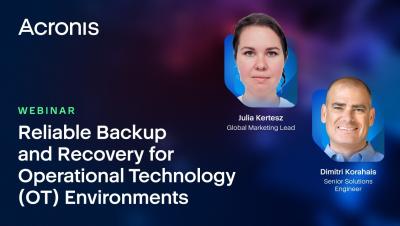
Modern ransomware doesn't just encrypt systems—it targets backups too. In this webinar, learn why recovery often fails even when backups exist, how attackers compromise backup environments, and what it takes to build a ransomware-resilient backup strategy. Ideal for MSPs and IT professionals looking to strengthen cyber resilience and recovery readiness.