Security | Threat Detection | Cyberattacks | DevSecOps | Compliance

CloudCasa DR for HPE Alletra with Red Hat OpenShift - PART 1: Failover

CloudCasa orchestrates disaster recovery failover for stateful workloads across two HPE Alletra arrays running Red Hat OpenShift. In this demo, we fail over a file server application from Site A (HPE Alletra 9060) to Site B (HPE Alletra MP B10000), with CloudCasa installing its agent via a single kubectl apply, discovering both clusters and storage systems, mapping the pre-configured HPE replication relationship, and triggering consistency group failover so the workload comes back up on Site B with all data intact.

Acronis Cyber Frame

Learn how service providers can capitalize on VMware migration, hyperscaler repatriation, and sovereign cloud opportunities with Acronis Cyber Frame. Explore a secure HCI and IaaS platform built for MSPs and CSPs, featuring integrated backup, DR, security, and RMM to help deliver profitable infrastructure services with greater control and flexibility. Like, comment, and subscribe for more Acronis tutorials!

VMware ESXi USB Passthrough Explained | Configure USB Devices in Virtual Machines Step-by-Step

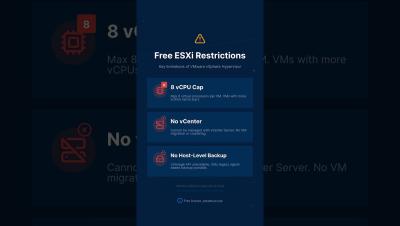
VMware ESXi USB Passthrough Overview and Configuration Need to connect a physical USB device directly to a VMware virtual machine? In this video, we explain how USB Passthrough works in VMware ESXi and provide a step-by-step guide to configuring USB devices for your VMs. You'll learn about the key components that make USB passthrough possible, including the USB Arbitrator Service, USB Controllers, and physical USB devices. We also cover USB 3.0 requirements, vMotion compatibility, common limitations, and troubleshooting tips.

Near-Zero RPO: What It Takes to Lose No Data

The gap between your last backup and a failure defines exactly how much data disappears. That gap is your recovery point objective (RPO), and teams running production workloads on OpenShift and KubeVirt find that most traditional DR tools simply don’t understand the environment well enough to close it. Near-zero RPO requires synchronous replication at the block level. Data must hit both your primary and DR site simultaneously.

How to Set Up VMware ESXi Lab - A Complete Guide

VMware is one of the best virtualization platforms in the world, popular among IT specialists for its ability to provide high-speed operations, reliability, scalability, security, and convenience. VMware ESXi Server is a type 1 hypervisor designed to be installed directly on physical servers, that is, it is a bare metal hypervisor. VMware type 2 hypervisors (VMware Player, Workstation, and Fusion), on the other hand, can be installed on existing operating systems running on desktops and laptops.

VMware Workstation Pro vs VMware Workstation Player: A Complete Comparison Guide

As a virtualization market leader, VMware offers products for a wide range of users. Its enterprise-grade line includes VMware vSphere products like ESXi, which is a type 1 hypervisor. VMware also offers type 2 hypervisors like VMware Workstation Player (or VMware Player) and VMware Workstation Pro (or VMware Workstation). Type 2 hypervisors are installed on the underlying host OS running on the physical machine.

BDRShield by Vembu Powers RainDrive - A New Managed Backup & Disaster Recovery Service for Indian Businesses

India’s data protection landscape is changing. With the Digital Personal Data Protection Act bringing new compliance obligations to the fore, businesses across the country are being forced to think more...

Beyond the checklist: Why operational resilience is reshaping cybersecurity compliance

The days when compliance was just a documentation exercise are long gone. Now, it’s a critical priority for a wide variety of organizations. But compliance is more of a result than a goal. The goal is achieving resilience. Cybersecurity and data protection regulations are rapidly evolving far beyond traditional compliance checklists. Global frameworks and regulations such as NIS 2, DORA, GDPR, HIPAA, SOX and NIST 2.0 are placing greater emphasis on operational resilience.

Backup retention policy best practices: A complete guide for enterprises

Many organizations invest heavily in backup solutions but still face a critical gap: the absence of a well-defined backup retention policy. Without a structured retention policy, backups may either be stored longer than necessary, driving up costs, or deleted prematurely, increasing compliance risks and limiting recovery options. In critical scenarios like ransomware attacks or system failures, organizations may find that their backups are incomplete, outdated, or unusable.

7 Agentic AI Security Threats in DevOps That Multiply Your Attack Surface

AI adoption in the DevOps field has been extensive. Developers use agents daily to broaden context, automate coding, prototype, etc., saving time and minimizing the footprint of mundane tasks. But it’s not all about gains. Agentic AI enables and introduces security threats that were unknown just a few years ago. With machine speed and scale, these can impact your corporate repos in a number of highly dangerous ways. The trend is on the rise, including at the level of popular DevOps platforms.