Security | Threat Detection | Cyberattacks | DevSecOps | Compliance

TanStack Npm Packages Compromised Inside The Mini Shai Hulud Supply Chain Attack

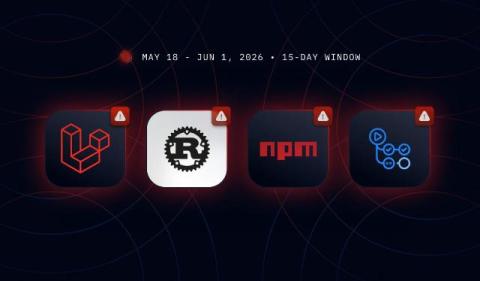
On May 11, 2026, between 19:20 and 19:26 UTC, 84 malicious npm package artifacts were published across 42 packages in the @tanstack namespace. The packages were not published by an attacker who stole credentials; they were published by TanStack's legitimate release pipeline, using its trusted OIDC identity, after attacker-controlled code hijacked the runner mid-workflow. The malicious versions spread to Mistral AI, UiPath, and dozens of other maintainers within hours.

PhantomRaven Wave 5: New Undocumented NPM Supply Chain Campaign Targets DeFi, Cloud, and AI Developers

Mend’s security research team has identified a previously undocumented fifth wave of the PhantomRaven campaign, an ongoing NPM supply chain attack that has been stealing developer credentials and secrets since August 2025. This new wave uses a fresh command-and-control server, 33 new malicious packages, and a more sophisticated three-stage payload chain.

The Shadow Supply Chain: A Pivot To Usage-Based Discovery

We’ve established the new forensic reality: a massive 72.9% inventory gap exists between the vendors you monitor and those invisible to your security. We have seen the shortcomings of SSO and its inability to holistically monitor all the vendor applications your users engage with, along with a Shadow AI explosion that is compounding both issues. The era of procurement-only discovery is over. To secure the modern cyber workforce, we must pivot from "buying-based" to usage-based discovery.

'Mini Shai-Hulud' supply chain attack targets SAP npm packages

On April 29, 2026, security researchers detailed a campaign known as ‘mini Shai-Hulud’ that involves compromised versions of npm packages used in SAP’s Cloud Application Programming Model (CAP). The malicious packages reportedly contain functionality to steal sensitive data such as credentials. The stolen data is encrypted and exfiltrated via public GitHub repositories. The maintainers of known-compromised packages have released updated versions.

How to Evaluate Security Tools for the Software Supply Chain

Engineering teams today face a dual mandate: ship high-quality features faster while keeping the underlying infrastructure secure. As development velocity increases, so does the complexity of the tools, libraries, and third-party components that make up your applications. The challenge? Your application’s security is now tied to a vast supply chain of code you didn’t write.

It's time to treat browser extensions like supply chain attack vectors

You would never install an application that can log into your Google docs, read your keystrokes in your browser, intercepts requests in transit, runs continuously, updates silently, AND could be powerful enough to steal your passwords, right? Well, this is more or less what browser extensions can do, and they create vulnerabilities that extend beyond one computer and or even one company.

Supply chain attacks hit Checkmarx and Bitwarden developer tools

Sophos X-Ops is aware of reports that two widely-used developer tools – the Checkmarx KICs security scanner and the Bitwarden CLI – were hijacked on April 22, 2026, to steal credentials from development environments. These attacks occurred within hours of each other and share the same command-and-control (C2) domain – potentially pointing to a single threat actor running a coordinated campaign. Both vendors have since reportedly contained the incidents.

Is Shai-Hulud Back? Compromised Bitwarden CLI Contains a Self-Propagating npm Worm

Version 2026.4.0 of the widely-used @bitwarden/cli npm package (78,000 weekly downloads) has been identified as malicious. The package contains a sophisticated multi-stage credential theft worm that explicitly names itself "Shai-Hulud: The Third Coming", a direct callback to previous Shai-Hulud supply chain campaigns, and targets developer credentials including SSH keys, cloud secrets, and even MCP configuration files.

No Off Season: Three Supply Chain Campaigns Hit npm, PyPI, and Docker Hub in 48 Hours

Three supply chain attacks hit npm, PyPI, and Docker Hub between April 21–23, 2026. All three targeted secrets: API keys, cloud credentials, SSH keys, and tokens from developer environments and CI/CD pipelines.

Building a Governed AI Model Supply Chain: Integrating AWS SageMaker and the JFrog Platform

Amazon SageMaker accelerates the process of training and deploying machine learning models. However, as AI adoption scales from individual experiments to enterprise-wide production, the focus of leading Fortune 500 software development operations and security teams must shift from pure velocity to governance.