Security | Threat Detection | Cyberattacks | DevSecOps | Compliance

Stop digging, just ask: get renewal-ready AI and SaaS reports in seconds

The information you need before a renewal meeting usually exists in SaaS Manager. Getting to it is another matter, because you have to know which report holds it, how to filter it, and whether the results actually answer the question you were asked. For an IT admin who works in the product daily, that's a minor detour. For a colleague in finance who opens SaaS Manager a few times a quarter, it can be the reason the question goes back to IT instead.

AI Agent Security: The Hidden Threat Your Firewall Can't Stop

If your AI security strategy is focused on stopping copy-pastes into chatbots, you're fighting yesterday's war. AI agent security is now the real endpoint challenge — autonomous agents operating with your users' credentials. Traditional firewalls, CASBs, and DLP weren't built for agentic AI. They can't see delegated credentials, multi-step tool calls, or live runtime execution across IDEs, browsers, and local apps.

Gen's Curtis Koenig on treating AI agents like human users to prevent security failures

Your backlog of low and medium severity vulnerabilities just became a real threat. AI can now chain them into critical exploits, and the window between exploit discovery and active use is around eight hours. Curtis Koenig, Head of Application Security at Gen, joins the show to explain why treating AI agents like human users is the single most important step security teams can take this year. CHAPTERS.

Which AI Signals Carry a Finding and Which Only Size It

A correlation rule joins several telemetry sources and fires when they agree. Guidance on writing them concentrates on thresholds, ordering and tuning for noise. ‍ The decision that determines whether a rule works is upstream of all of that. Each source in a rule plays one of three roles, and treating them interchangeably is what produces a rule that misses real events or fires on ones nobody can act on. ‍

If AI Can Build the Exploit, It Can Write the Patch

The window between an exploit being discovered and actively used is around eight hours. Curtis Koenig, Head of Application Security at Gen, explains why zero trust and a prepared incident response process remain the foundation for security teams navigating this new threat landscape. "The good news is that if the tool can find a vulnerability and create an exploit, it can find a vulnerability and write a patch as well.".

Why Open Source Is the Easiest Target for Supply Chain Attacks

Attackers targeting open source dependencies already have all the code they need. Curtis Koenig, Head of Application Security at Gen, explains the fundamental asymmetry and why building quality fixes at speed is the real challenge for defenders. "An attacker can produce very fast, very ugly code that propagates through as an attack. When we're trying to fix something, the challenge we have is we're always trying to build for quality.".

Treat Your AI Agents Like Humans or You Are Creating Risk

AI agents are about to act as humans inside your organization. Curtis Koenig, Head of Application Security at Gen, explains why treating them with the same identity and data controls is the single most important step to get ahead of AI risk. "We're going to give these agents the capability to do things as though they were humans. If we are not treating them like we treat our other human users in our organizations, that's where we're creating risk.".

How the Arctic Wolf Agentic SOC Delivers Faster, More Accurate Security Outcomes

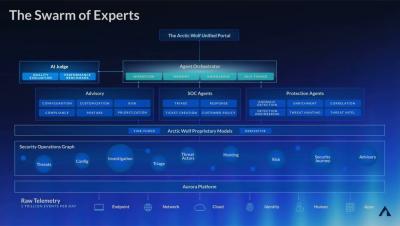
Learn how Arctic Wolf Superintelligence Platform and the Swarm of Experts work together to deliver faster, more accurate outcomes for customers by leveraging unmatched telemetry, deterministic models, our golden data set and human expertise.

Bring Your AI. Give It Reach. | Reach Security

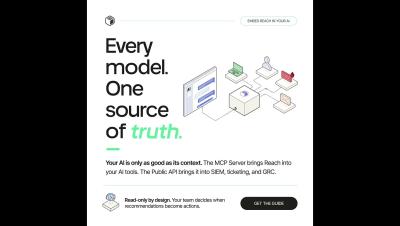
Point an AI model at a security stack it doesn't fully understand and you get confident, wrong answers faster. Reach gives your AI a source of truth for security controls. The MCP Server connects MCP-compatible AI tools directly to Reach. The Public API brings Reach findings and evidence into SIEM, ticketing, and GRC workflows. The MCP Server is intentionally read-only, so your team decides when recommendations become actions.