Security | Threat Detection | Cyberattacks | DevSecOps | Compliance

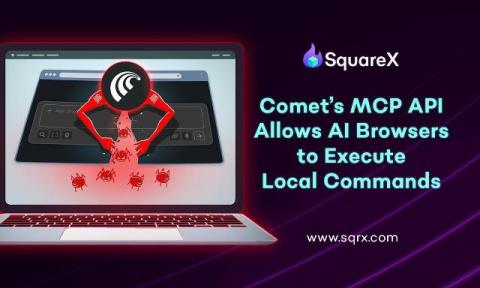
Obscure MCP API in Comet Browser Breaches User Trust, Enabling Full Device Control via AI Browsers

SquareX released critical research exposing a hidden API in Comet that allows extensions in the AI Browser to execute local commands and gain full control over users' devices. The research reveals that Comet has implemented a MCP API (chrome.perplexity.mcp.addStdioServer) that allows its embedded extensions to execute arbitrary local commands on users' devices, capabilities that traditional browsers explicitly prohibit. Concerningly, there is limited official documentation on the MCP API.
OWASP Named Software Supply Chain Failures. Now It's Time to Fix Them.

Since OWASP unveiled its 2025 Top 10, one of the most-discussed items has been A03: Software Supply Chain Failures. For many in AppSec, this came as no surprise; enterprise software’s reliance on open source has become one of its greatest strengths and arguably its biggest liability.

UK Cyber Security and Resilience Bill: What you need to know

The UK government introduced the Cyber Security and Resilience Bill to Parliament on November 12th, 2025. Science, Innovation and Technology Secretary Liz Kendall stated: “Cybersecurity is national security. This legislation will enable us to confront those who would disrupt our way of life.” If you work in healthcare, energy, water, transport, or supply IT services to these sectors, this legislation will directly affect how you manage cybersecurity.

How Managed Cybersecurity Services Reduce Risk and Enable Business Growth

Today's organizations of all sizes face increasing pressure to protect sensitive data, maintain compliance, and defend against sophisticated cyberattacks. At the same time, they must continue innovating, scaling, and delivering exceptional customer experiences. This dual mandate-security and growth-can feel at odds for many companies.

How Outpost24 delivers operational resilience for DORA

The EU’s Digital Operational Resilience Act (DORA) has just turned a year old. This regulation represented a fundamental shift in how the financial sector manages ICT risk, moving beyond traditional compliance to demand continuous, demonstrable digital operational resilience. A year on, the focus has changed. Organizations can no longer just avoid cyber incidents. They need to prove they can withstand, respond to, and recover from disruptions quickly and effectively.

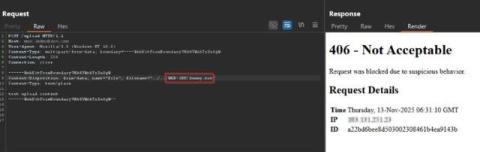
CVE-2025-55752: Apache Tomcat Path Traversal Vulnerability

Apache Tomcat continues to play a central role in hosting Java-based web applications across enterprises, cloud services, and government systems. Its reliability and lightweight architecture make it a go-to choice for developers, but its ubiquity also means that a single vulnerability can have widespread security implications. CVE-2025-55752, disclosed in late 2025, highlights how a subtle processing regression can evolve into a high-impact vulnerability under the right conditions.

CVSS Is a Little Bit of Risk: Rethinking CVSS in Vulnerability Prioritization

The best part about my job is that I sometimes get to make some controversial statements. Well, as controversial as things can be in a niche area of cybersecurity like “what is a reasonable measure of vulnerability risk?” Along with my colleague Sander Vinberg we got to explore this question earlier this year at the second Annual VulnCon conference in Raleigh. Even though it’s only been held twice, it is quickly becoming one of my favorite conferences.

Django Vulnerabilities Expose Apps to SQL Injection & DoS Attacks

The Django Software Foundation has released critical security fixes for CVE-2025-64459 (SQL Injection) and CVE-2025-64458 (Denial of Service) vulnerabilities. These vulnerabilities affect query construction and redirect handling in Django, putting applications and data at risk. See how AI-powered AppTrana stops these attacks from Day 0.