Security | Threat Detection | Cyberattacks | DevSecOps | Compliance

The Role of AI Security Agents in Modern Exposure Management

AI security agents are reshaping how organizations manage exposure. This blog explores where they deliver the most impact — from smarter prioritization to faster ownership mapping and assisted remediation — and how this shift moves security teams from automation to autonomy.

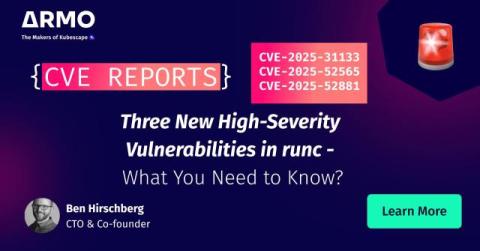
Three New High-Severity Vulnerabilities in runc: What You Need to Know

Within 24 hours, three new high-severity vulnerabilities were disclosed in runc, the low-level runtime that underpins most container platforms, including Docker, containerd, Kubernetes, and nearly every major cloud provider’s managed Kubernetes service. These vulnerabilities (CVE-2025-31133, CVE-2025-52565, CVE-2025-52881) allow a malicious container image to break out of the container boundary and affect the host machine directly.

Scaling Exposure Management: Program Maturity and Continuous Optimization

Building an exposure management program is just the beginning of a long journey. True success comes from scaling that program through continuous optimization, measurable progress, and organizational alignment. As enterprises expand their digital footprint, exposure management must evolve from reactive vulnerability remediation to a proactive, data-driven discipline that continuously strengthens resilience.

Clarity in Exposure Management

Vulnerability reports shouldn’t read like riddles. Seemplicity’s Clarity AI Agent transforms dense, technical scanner output into clear, contextual language everyone can understand — bridging the gap between security, IT, and engineering. Discover how Clarity makes every finding readable, actionable, and ready for remediation.

APT-C-60 Exploits Zero-Day Vulnerabilities: Inside the SpyGlace Loader, COM Hijacking, and C2 Infrastructure

The cyber espionage landscape continues to evolve in sophistication and stealth—and among the more notable actors is APT-C-60. In recent months, this adversary has significantly escalated its tactics by leveraging zero-day vulnerabilities and orchestrating multi-stage campaigns to deploy the SpyGlace back-door.

Seemplicity's AI Agents: Clarity

Meet Clarity, the first of Seemplicity’s four new AI Agents transforming how security teams understand and act on vulnerabilities. Instead of cryptic scanner outputs and confusing CVE text, Clarity turns dense technical data into clear, actionable narratives — explaining what happened, why it matters, and how to fix it. With Clarity, you can: Translate vulnerability data into plain language Improve collaboration between security, IT, and engineering Accelerate remediation and reduce exposure fatigue.


Why Mid-Market Organizations Can't Afford to Ignore Open Source Vulnerabilities

There are millions of dollars on the line for companies relying on open source. Failure to stay CVE-free can lead to churn, closed-lost deals, and countless engineering hours wasted chasing fixes instead of shipping features. Unlike enterprises with large budgets and compliance buffers, a single failed review, missed SLA, or unresolved CVE can derail $5M–$20M in just one quarter. This is the difference between hitting growth targets or missing them entirely.

Snyk Studio brings security scanning and automated fixes to Factory's Droids

Snyk is thrilled to announce our partnership with Factory, which brings Snyk Studio directly into Droid workflows. AI agents, such as Factory’s Droids, can generate thousands of lines of code at incredible speed and are transforming modern software development. Yet every time a Factory Droid quickly ships a feature in minutes vs. days, refactors an entire module, and updates dependencies across a repo, it’s potentially introducing vulnerabilities at the same pace.

What is Vulnerability Management Lifecycle? Different Stages and Best Practices

Do you know what’s common between downtime, data leaks, and compliance-related penalties? An issue known as an unpatched vulnerability. Tracking and managing system weaknesses is no longer a one-time task. It’s a full-time responsibility now because of the rise of cloud, IoT, and remote endpoints. To stay ahead of potential breaches, follow a continuous and methodical approach known as the vulnerability management lifecycle.