Security | Threat Detection | Cyberattacks | DevSecOps | Compliance

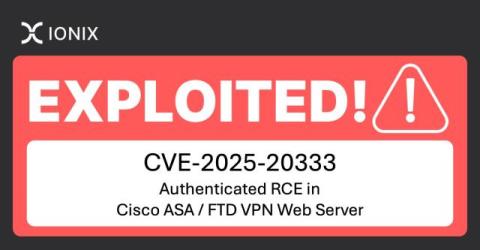
CVE-2025-20265: Maximum-Severity Remote Code Execution Vulnerability in Cisco Secure Firewall Management Center

On August 14, 2025, Cisco released fixes for a maximum-severity vulnerability affecting Cisco Secure Firewall Management Center (FMC) Software, tracked as CVE-2025-20265. FMC is the centralized platform used to manage security settings and network devices across Cisco Firepower and ASA deployments.

API Vulnerabilities and Attack Surface Management

ThreatX by A10 Networks: API Vulnerabilities and Attack Surface Management In this video, Carlo Alpuerto of A10 Networks discusses API security with Beau Hamilton of SourceForge. He explains that API security is a broad term that includes addressing vulnerabilities in the development cycle, which takes time and involves various stages like QA, staging, and UAT.

Adversary Tradecraft: Exploitation of the SharePoint RCE

CVE-2025-53770 and CVE-2025-53771 are critical remote code execution vulnerabilities (CVSS base score 9.8) impacting Microsoft SharePoint, a widely deployed enterprise collaboration and content management platform. In this blog, we will simulate the exploitation of this SharePoint RCE vulnerability and analyze the resulting telemetry inside Graylog.

MadeYouReset: An HTTP/2 vulnerability thwarted by Rapid Reset mitigations

On August 13, security researchers at Tel Aviv University disclosed a new HTTP/2 denial-of-service (DoS) vulnerability that they are calling MadeYouReset (CVE-2025-8671). This vulnerability exists in a limited number of unpatched HTTP/2 server implementations that do not sufficiently enforce restrictions on the number of times a client may send malformed frames. If you’re using Cloudflare for HTTP DDoS mitigation, you’re already protected from MadeYouReset.

Understanding Network Vulnerabilities and Mitigating Their Risks

Driving along on a dark highway late at night, you feel a jolt and hear a metallic crushing sound as your car hits an unknown object in the road. You nervously continue on your journey, until you see a bright light flashing on your dashboard. Your oil pressure is low because your car has been leaking oil since you hit that unknown object on the highway. Much like an unknown object in the road that leads to a slow leak, a network vulnerability can lead to a devastating data leakage or breach.