Security | Threat Detection | Cyberattacks | DevSecOps | Compliance

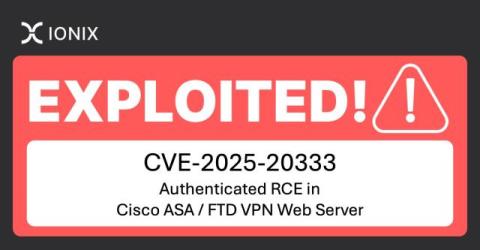
CVE-2025-20333: Authenticated RCE in Cisco ASA / FTD VPN Web Server

A high-severity vulnerability (CVSS 9.9) has been disclosed in the VPN web server component of Cisco Secure Firewall ASA and FTD software. An authenticated attacker (i.e. one possessing valid VPN credentials) can send specially crafted HTTP(S) requests that bypass input validation and lead to remote code execution as root. This means full device compromise is possible.

Malicious MCP Server on npm postmark-mcp Harvests Emails

On September 25, 2025, the npm package postmark-mcp, an MCP (Model Context Protocol) server intended to let AI assistants send emails via Postmark, was reportedly modified to secretly exfiltrate email contents by adding a blind-copy (BCC) to an external domain. Current analysis suggests the behavior began around 1.0.16 and persisted in later versions.

Olymp Loader: A new Malware-as-a-Service written in Assembly

Olymp Loader is a Malware-as-a-Service (MaaS) advertised on underground forums and Telegram since June 5, 2025. The seller, “OLYMPO”, presents Olymp Loader as fully written in assembly language and frequently markets it as FUD (Fully UnDetectable). Despite its recent appearance, many underground forum users have already posted positive reviews.

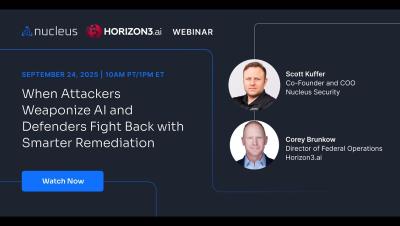
When Attackers Weaponize AI and Defenders Fight Back with Smarter Remediation

Artificial intelligence is transforming cybersecurity, and not always for the better. Attackers are now weaponizing AI to speed up reconnaissance, create exploit code, and bypass traditional defenses. Security teams can’t afford to rely on outdated vulnerability management practices. In this webinar, Scott Kuffer (COO, Nucleus Security) and Corey Brunkow (Director of Federal Operations, Horizon3.ai) break down how AI is changing the threat landscape and what defenders can do to stay ahead.


How Snyk Learn Helps You Meet PCI DSS v4.0 Developer Training Requirements

As businesses strive to secure sensitive cardholder data and stay compliant with Payment Card Industry Data Security Standard (PCI DSS) v4.0.1, one of the most overlooked areas is developer training. The latest version of the PCI DSS places clear emphasis on ensuring developers are not only residually aware of security best practices, but are actively trained to build secure software and detect vulnerabilities. This is where Snyk Learn comes in.

CVE-2025-26399: Critical Unauthenticated RCE in SolarWinds Web Help Desk Through Second Bypass

On September 23, 2025, SolarWinds released a hotfix for a critical vulnerability impacting Web Help Desk (WHD), tracked as CVE-2025-26399. The vulnerability arises from a deserialization flaw in the AjaxProxy component that could allow a remote unauthenticated threat actor to achieve remote code execution. CVE-2025-26399 is the second bypass of a flaw originally disclosed last year as CVE-2024-28986 within WHD, with the first bypass being CVE-2024-28988.

Exploitability as the Countdown Clock: Prioritizing Vulnerabilities Before Time Runs Out

In vulnerability management, every scan tells a story. The truth is that only some of those stories matter right now and that the challenge isn’t finding vulnerabilities. It’s knowing which ones are about to cost you. If you’re dealing with hundreds of vulnerabilities per asset, especially if you’ve adopted cloud solutions, you’re not alone. That’s become the norm. But you can’t patch everything, and you shouldn’t even try.