Security | Threat Detection | Cyberattacks | DevSecOps | Compliance

It's Not If Attackers Get In. It's What Happens Next | Insurity CISO Jay Wilson

"Usually it's not a question of if the bad guys get in. It's a question of what happens when they do." Jay Wilson, CISO and CIO at Insurity, and Garrett Hamilton, CEO of Reach, joined Shubhangi Dua on The Security Strategist from EM360Tech to talk about why the controls you already own are where exposure quietly builds up. That's Jay's line, and one every security leader has lived. Defense in depth only holds if every inner layer is configured the way you think it is. The outer door gets the attention. The inner doors are where incidents actually get stopped, or don't.

The Ultimate Guide to API Security in AI Applications

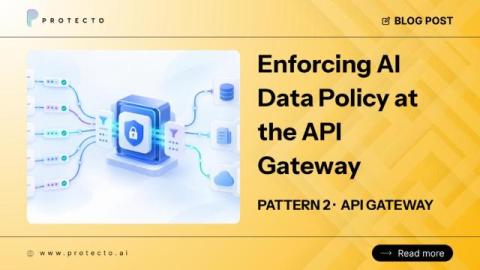
API security is the practice of protecting the interfaces that connect your applications, models, and data from unauthorized access, abuse, and data theft. In AI applications, APIs carry prompts, model responses, customer PII, and agent instructions, which makes them the single most exposed layer of your AI stack. Securing them requires authentication, rate limiting, encryption, and a layer most teams miss: protection of the sensitive data in every API call.

Why Technology Companies Are Investing in Drone App Development

The global drone market is expanding at an impressive pace, driven by advances in automation, artificial intelligence, cloud computing, and connectivity. While drone hardware continues to evolve, software has become the primary factor that determines how effectively organizations can leverage these technologies. Companies working with companies, such as Wezom, on custom drone app development projects are discovering new ways to automate operations, improve data visibility, and create scalable digital ecosystems that support long-term growth.

Best AI Red Teaming Tools: Top 7 in 2026

There was a time when “AI red teaming” sounded like a novelty. Now, it’s fast becoming table stakes. If your organization is shipping machine learning or LLM-powered systems into the real world (especially in sensitive domains), you need to know how those systems behave under pressure. That’s where AI red teaming tools come in. These tools help teams stress-test AI the way it will actually be used (and misused).

Enforcing AI Governance: Why Standard Chatbots Lack Baked-In Security

Enforcing AI Governance: Why Standard Chatbots Lack Baked-In Security Arjoyita Roy and Luca Labardini from A10 Networks discuss the security risks of deploying AI chatbots with functional tool-calling capabilities, particularly in highly regulated sectors such as financial services.

Attackers Use Spoofed ChatGPT Site to Deliver Malware

Researchers at Malwarebytes warn that a fake ChatGPT download site is delivering malware. The attackers use sponsored results and SEO manipulation to target users who search for “ChatGPT download.” The phishing page is a convincingly spoofed version of the legitimate ChatGPT website, which delivers malware tailored to Windows or Mac users.

How Bitsight Supports Hong Kong's Critical Infrastructure Ordinance Cap. 653 in the Post-Mythos Era

Hong Kong’s Protection of Critical Infrastructures (Computer Systems) Ordinance (Cap. 653) represents a major shift in cybersecurity regulation. The law moves beyond traditional compliance exercises and places a much stronger emphasis on continuous operational resilience. For designated Critical Infrastructure (CI) operators, the challenge is no longer simply deploying security controls.

Stop AI-powered fraud rings with link analysis

Sophisticated fraudsters optimize and scale their systems to grow ROI. That's also a weakness you can exploit to shut down fraud rings before attacks scale. Fraud experts Nisreen Hussain, Irfan Faizullabhoy, and Ashley Fang show how pattern and link analysis stops AI-powered fraud, account takeovers, and large fraud rings. In the full webinar.

Vulnerability Remediation Takes More Than Just an AI Agent

AI agents can investigate a single vulnerability brilliantly, but that is only about 20% of vulnerability remediation. This post breaks down the other 80%: the data normalization, cross-tool asset identity, SLA enforcement, exception governance, and audit evidence that turn individual agent outputs into a governed, provable remediation program, and why AI and a platform like Seemplicity work better together than apart.

How to Detect and Prevent AI Insider Threats

The rapid adoption of generative AI has transformed enterprise productivity, but it’s also quietly introduced a new, sophisticated vulnerability: the AI insider threat. For years, securing the internal perimeter meant watching for data exfiltration via USB sticks or unauthorized emails. Today, the risk looks entirely different.