

Security | Threat Detection | Cyberattacks | DevSecOps | Compliance

How to Identify and Track AI Use Across Business Units

Tracking AI use across business units requires a purpose-built approach that combines endpoint monitoring, browser-level telemetry, network security tools, and a centralized AI governance platform. Most organizations rely on some combination of IT asset management, SaaS monitoring, and manual surveys to understand what AI tools employees are using.

Microsoft Copilot SharePoint Integration for Drupal

Someone asks for a project proposal from six months ago. You remember the client. You remember the meeting. The only thing you don't remember is where the document lives. That's a familiar situation for many teams. A Microsoft Copilot SharePoint Integration for Drupal gives users a quicker way to access SharePoint content from Drupal. They can find information, review documents, and complete common tasks without leaving the platform.

Why AI Governance Without Guardrails Is Theater

AI governance is a key enterprise concern. Organizations are assembling councils, publishing principles, rolling out “approved AI tools” lists, and asking employees to opt in to acceptable use policies. In most enterprises, however, the reality is that AI is already widely embedded in employees' daily work, often outside sanctioned channels and oversight. The visibility and control mechanisms needed to govern AI use are immature or nonexistent.

Prompt Injection and the Rise of Agentic Risk

Boxers will often say, the punches that hurt the most aren’t the ones which are thrown with the most force, but the ones they didn’t see coming. I think the same is true in cybersecurity. It’s not the most advanced technically efficient, 0-day utilizing attacks that have the biggest impact, but rather those quiet ones. With no malware or suspicious login at three in the morning from an IP address in a country your company has never done business with. No alert fires.

AI Pentesting Buyer's Guide: How to evaluate AI pentesting vendors

Pentesting made sense when releases happened every few months. A point-in-time assessment could provide an accurate picture of risk for weeks, sometimes months. Today, engineering teams ship continuously. Our State of AI in Pentesting survey of 200 CISOs and 200 engineering leaders, found that 76% deploy significant changes at least weekly, while nearly 40% deploy daily. Yet only 21% validate security on every release. That gap has consequences.

MCP Supply Chain Security: How Malicious MCP Servers Are Infiltrating Enterprise AI Environments

Every enterprise deploying AI agents is building on a foundation of third-party MCP servers they don’t control, can’t verify, and barely track. The security conversation keeps focusing on the model – prompt injection, jailbreaks, hallucinations. That’s the wrong place to look. We’ve covered why that framing falls short elsewhere too – see System Prompts Are Not Security Boundaries. Business Logic Graphs Are.

AI Innovation Challenge: Help Shape the Future of Cybersecurity

Artificial intelligence is transforming cybersecurity, and Managed Service Providers (MSPs) are at the forefront of that evolution. That's why we're launching the WatchGuard AI Innovation Challenge, an opportunity for MSPs to share ideas for AI agents and automations that help security teams work smarter, operate more efficiently, and better protect their customers.

Shadow AI - The Hidden Risk in Every Pocket

Shadow AI is already on your employees' phones — and it's invisible to your network controls. This demo follows a real workflow: an employee gets blocked from using an unauthorized AI tool on her corporate laptop, so she switches to her personal phone instead. No VPN, no DLP, no visibility, no corporate controls follow her there.

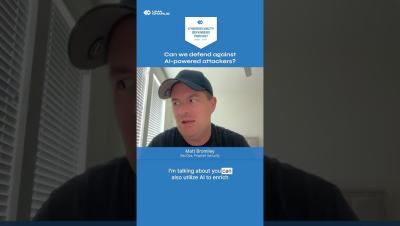
Can we defend against ai-powered attackers?

In this week's Intel Chat, Chris Luft and Matt Bromiley discuss how the same AI capabilities fueling adversaries are available to defenders too. Matt's takeaway: you don't need to buy an AI product to keep pace. The same way an attacker points AI at a code base, defenders can point it at detection rules and telemetry. Chris adds that as more developers use these models to check their own code, the playing field will level out, though the next year or two will likely bring a spike in exploits from lower-skilled attackers leveraging AI before defenses catch up.