Security | Threat Detection | Cyberattacks | DevSecOps | Compliance

How to Measure Configuration Drift (And Why Alerts Get Ignored)

Configuration drift isn’t just “change.” It’s unmanaged change. Let's get practical about how teams should actually measure drift: ⇢ What type of change occurred⇢ How often those changes happen⇢ How critical they are in real context⇢ And—most importantly—how teams respond Volume alone isn’t the metric that matters. If changes pile up without response, alerts get ignored—and drift quietly becomes exposure.

The Asymmetric Threat: Why AI API Traffic is Hard to Predict

The Asymmetric Threat: Why AI API Traffic is Hard to Predict As AI becomes more integrated into business operations, the way data moves through APIs is changing. In this clip from the A10 Networks webinar, "APIs are the Language of AI: Protecting Them is Critical," experts Jamison Utter and Carlo Alpuerto break down the concept of data asymmetry in AI.

Why Vulnerability Management Falls Short - And How Exposure Management Fixes It

Vulnerability management identifies weaknesses. Exposure management helps prioritize them based on real-world risk and context. Ed and Garrett unpack why traditional vulnerability programs struggle to drive real risk reduction. The challenge isn’t discovery. It’s prioritization and follow-through. Too often, vulnerabilities are treated as isolated IT tasks—handed off, tracked by SLAs, and stripped of the context that explains why they matter in the first place.

Top 3 Skills for AI Security in 2026 #shorts

Are your cybersecurity skills ready for the AI era? In this clip, we reveal which traditional security frameworks still work and the one new mental shift you need to survive. It’s not just about code anymore—it’s about "Socio-Technical" thinking. Raji (Microsoft AI Security) breaks down exactly how to future-proof your career.

ITSP / StudioC60 features Memcyco in latest podcast.

Real-Time Defense Against AI-Driven Account Takeover: How Memcyco Protects Organizations and Their Customers Memcyco recently featured in an ITSP Magazine podcast episode snippet, which this post is based on. You can listen to the full feature here. Our thanks go to the podcasters for having our CEO, Israel Mazin, on with them.

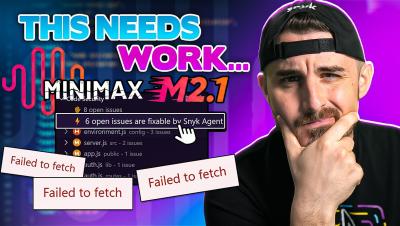
Testing MiniMax M2.1 for AI Coding: The Results Might Surprise You

Can "lesser-known" AI models actually keep up with the giants like Google, OpenAI, and Anthropic? In today’s video, we put MiniMax M2.1 to the ultimate test: building a production-ready, secure Node.js note-taking application from a single prompt. We’ll explore how to access MiniMax natively in the Windsurf IDE, walk through the debugging process for common errors (like environment variables and OS-specific dependencies), and perform a deep-dive security audit using Snyk. Stick around until the end to learn how to integrate MiniMax M2.1 into VS Code using OpenRouter.