Security | Threat Detection | Cyberattacks | DevSecOps | Compliance

Addressing cybersecurity challenges in open source software with the Linux Foundation

Snyk recently partnered with the Linux Foundation to produce a report focusing on the state of security in the open source software (OSS) space. The report was based on 550+ survey responses and 15 interviews with OSS maintenance and cybersecurity experts. Following the report’s publication, experts from Snyk held a webinar with the Linux Foundation to discuss some of the key insights.

CVE-2022-26136 & CVE-2022-26137 - Multiple Critical Vulnerabilities in Atlassian Products

On Wednesday, July 20, 2022, Atlassian released patches to remediate two critical vulnerabilities (CVE-2022-26136 and CVE-2022-26137) that impact how Atlassian products implement Servlet Filters and could lead to unauthenticated authentication bypass, cross-site scripting (XSS), or cross-origin resource sharing (CORS) bypass depending on the filters used by each impacted product.

Webinar recap: The missing story with every cloud breach

Snyk’s Chief Architect, Josh Stella, recently hosted a webinar about cloud security. Stella was the co-founder and CEO of Fugue, a cloud security and compliance company that was acquired by Snyk. With the capabilities of Fugue, Snyk will bring its developer-first security platform into the cloud security space. During this talk, Stella discussed the missing story in every cloud breach: the tale of how, when, and where attackers operate in the cloud.

Top 5 tips for C++ security

C++ has become a pivotal part of the modern day tech industry. It has been used for multiple purposes, such as desktop applications, server applications, gaming, virtual reality, internet of things firmware, and even as the foundation for many modern day programming languages. Since the initial C++ release in 1985, as an extension to the C programming language, it was designed with an orientation towards system programming and embedded resource development.

How to Conquer Remote Code Execution (RCE) in npm

Recently, there have been some remote code execution (RCE) attacks that included just a single line of well-built code that can run a remote shell. Let’s take a look at why and how these attacks work, why npm is particularly susceptible, what could happen if they get into machines, and how to detect and fix them.

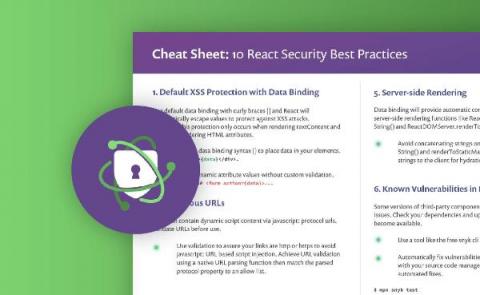
10 React security best practices

The date on this post reflects its latest update. This post was originally published on October 28, 2020. Looking for the best ways to secure your React app? Then you’ve come to the right place! We’ve created this checklist of React security best practices to help you and your team find and fix security issues in your React applications. We’ll also show you how to automatically test your React code for security-related issues and automatically fix them. Let’s get to it!

Decade Retrospective: The State of Vulnerabilities

The Spanish philosopher George Santayana is credited with the aphorism “Those who cannot learn from history are doomed to repeat it.” This statement is particularly true when it comes to cybersecurity. Threat actors reuse well-known and previously patched vulnerabilities and attempt to take advantage of organizations making the same error over and over. So, if one does not know what has recently taken place it leaves you vulnerable to another attack.

What's the Difference Between Penetration Testing vs Vulnerability Scanning?

Penetration testing and vulnerability scanning are both important practices that protect the network of a business. However, the two are very different from each other in the way they test the security and vulnerabilities of a network. Keep reading to learn more about the differences and how to decide whether one or both would best suit your needs.

Netskope Threat Coverage: Microsoft Discloses New Adversary-in-the-Middle (AiTM) Phishing Attack

On July 12, 2022, Microsoft researchers disclosed a large-scale phishing campaign that has targeted more than 10,000 organizations since September 2021. The campaign used adversary-in-the-middle (AiTM) phishing sites to proxy the authentication process and hijack the victims’ Office 365 session cookies.

CVE Severity: Approaches for When & How To Manage Builds

In a-near perfect world, you would instantly fix your application every time a relevant CVE was issued. (In a truly perfect world, of course, there would be no security incidents, and hence no CVEs in the first place.) But in the real world, reacting to CVEs requires a careful calculation. You need to assess whether each CVE is serious enough to warrant the rejection of a build and a delay of a release.