Security | Threat Detection | Cyberattacks | DevSecOps | Compliance

Hackers hijack Google Smart Home #aisecurity #mcpserver

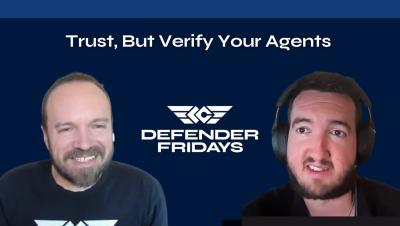
Building AI agents that can think, act, and adapt securely isn't easy. From prompt design to deployment, every stage brings new challenges and new risks. In this session, Bar-El Tayouri, Head of Mend AI at Mend.io, and Yehoshua (Shuki) Cohen, VP of Data and AI Evangelist at AI21 Labs, shared practical strategies for designing and defending agentic systems that actually deliver. Key topics covered: Originally recorded: October 29, 2024.

Malicious AI Tools Assist in Phishing and Ransomware Attacks

Researchers at Palo Alto Networks’ Unit 42 are tracking two new malicious AI tools, WormGPT 4 and KawaiiGPT, that allow threat actors to craft phishing lures and generate ransomware code. These tools are criminal alternatives to mainstream AI tools like ChatGPT, with no safety guardrails to prevent users from using them for malicious activities. The latest version of WormGPT offers lifetime access for $220, or a monthly fee of $50.

AI vs Security Architects - Augmentation, Not Replacement

Are AI systems replacing security roles? Maybe not the way most people assume. AI isn't eliminating architects — it's augmenting them. Architects sit at the strategic layer: influence, prioritization, long-term posture. AI’s power isn’t replacing that judgment — it’s continuously surfacing what matters, validating configurations, and helping teams scale impact without hiring “more architects.” "If I say something should be done, I need a way to know whether it was done correctly — and continuously.".

We Built Protecto SaaS Because $50K/Month Privacy Tools Didn't Make Sense for Startups

Six months ago, we encountered a problem with no clear solution. We were building an AI agent inside a startup. When customer conversations were flowing in, we started looking for privacy tools that could keep up. Everything we found fell into one of three buckets: Somewhere in the middle of this, we caught ourselves looking for a simple, affordable way to mask data before it hits AI systems.

LLMs, Quantum Computing, and the Top Challenges for CISOs in 2026

Cybersecurity in 2026 is entering its most transformative and volatile phase yet. For CISOs, the landscape is no longer defined only by web, network, and cloud threats. Instead, attackers now target AI/LLM systems, APIs, identity platforms, SaaS ecosystems and supply chains. The surge in attacks across applications, APIs, and GenAI systems indicates that adversaries are scaling faster, using automation, AI-assisted exploitation, and new social engineering vectors.

Delivering Intelligent IT Foundations for Safe AI Usage

JumpCloud CTO Greg Keller explains why traditional, fragmented IT tools create a critical Zero Trust gap for AI agents, bots, and non-human identities (NHIs). The biggest inhibitor to innovation isn't restrictive policy—it's the internal lack of a unified identity foundation. Learn how to address "identity sprawl" and transform IT operations to deliver auditable trust, extend Zero Trust enforcement to machine-to-machine interactions, and build the Intelligent IT foundations required for safe, accelerated AI adoption.

The Mythical 1+1=3 Model in Cybersecurity

The mythical 1+1=3 model in security? It happens when the tools you already own stop working in isolation — and start working as a system. Jay Wilson and Garrett Hamilton dig into why Reach’s platform approach matters: not just enhancing individual controls, but creating compounding value across identity, endpoint, email, and network. When visibility, configuration, and enforcement align, the outcome isn’t incremental — it’s exponential.

APIs are the Language of AI. Protecting them is Critical.

APIs are the Language of AI. Protecting them is Critical. In this discussion, A10 Networks security experts Jamison Utter and Carlo Alpuerto explore the emerging impact of Agentic AI on the API security landscape. They delve into how AI agents, as new API consumers, are driving an explosion in endpoints and exacerbating existing security issues, pushing API protection higher up the security practitioners' priority list.

Indirect Prompt Injection Attacks: A Lurking Risk to AI Systems

The rapid adoption of AI has introduced a new, semantic attack vector that many organizations are ill-prepared to defend against: prompt injection. While many security teams understand the threat of direct prompt injection attacks against AI agents developed by their organizations, another more subtle threat lurks in the shadows: indirect prompt injection attacks.