Security | Threat Detection | Cyberattacks | DevSecOps | Compliance

Best practices for containerizing Go applications with Docker

Containerization describes the creation of a self-contained computing environment that runs on a host machine and any operating system (OS) with an available container runtime engine. Built from an image, a container holds an app and the filesystem alongside configurations, dependencies, binaries, and other specifications needed to run it successfully. Containers are typically much smaller than virtual machines and run in the host’s OS rather than containing OSs themselves.

Getting Started with Kubernetes Ingress

Kubernetes Ingress is one of today’s most important Kubernetes resources. First introduced in 2015, it achieved GA status in 2020. Its goal is to simplify and secure the routing mechanism of incoming traffic to your defined services. Ingress allows you to expose HTTP and HTTPS from outside the cluster to your services within the cluster by leveraging traffic routing rules you define while creating the Ingress.

Cross-Account and Cross-Cluster Restore of Kubernetes Demonstrated on Amazon EKS

Cross-Account and Cross-Cluster Restore of Kubernetes Applications Using CloudCasa on Amazon EKS. Users can now browse and map the available storage classes in the source and destination cluster across different AWS accounts and different Cloud Providers such as AKS, GKE, DO, IBM Cloud etc.

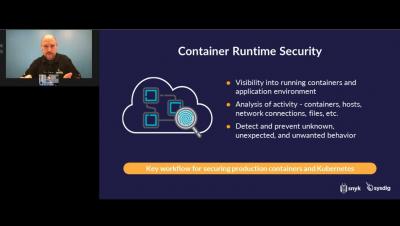
How to Secure Containers and Eliminate Noise from Code to Production with Sysdig and Snyk

This webinar recording presented by Snyk and our partner Sysdig shows how we are helping developers and security teams pinpoint must-fix open source and container vulnerabilities in development while effectively protecting workloads in production. Implementing a continuous feedback loop using runtime intelligence helps you save time by focusing remediation efforts on packages executed at runtime.

NSA & CISA Kubernetes Hardening Guide - what is new with version 1.1

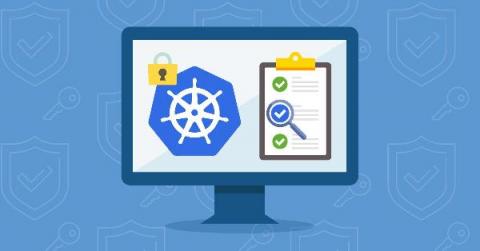
In March 2022, NSA & CISA has issued a new version of the Kubernetes Hardening Guide – version 1.1. It updates the previous version that was released in August 2021. Kubernetes evolves fast, and Kubernetes adoption grows even quicker. Kubernetes has become a very popular target and therefore requires continuous enhancement of the protection measures.

How to Stop Container Escape and Prevent Privilege Escalation

Container escape is a security risk in which malicious players can leverage a containerized application’s vulnerabilities to breach its isolation boundary, gaining access to the host system’s resources. Once an attacker accesses the host system, they can escalate their privilege to access other containers running in the machine or run harmful code on the host. Depending on how vulnerable the host is, the actor could also access other hosts in the network.

Mitigating CVE-2022-0811: Arbitrary code execution affecting CRI-O

A new vulnerability CVE-2022-0811, alias cr8escape, with CVSS 8.8 (HIGH) has been found in the CRI-O container engine by Crowdstrike. This vulnerability can lead to arbitrary code execution. The container engines affected are: Any containerized infrastructure that relies on these vulnerable container engines is affected as well, including Kubernetes and OpenShift (version 4.6 to 4.10).

Defense in depth with Calico Cloud

Last month, we announced the launch of our active cloud-native application runtime security. Calico Cloud’s active runtime security helps security teams secure their containerized workloads with a holistic approach to threat detection, prevention, and mitigation. As security teams look to secure these workloads, it’s also critical that they employ a defense-in-depth strategy.

IBM Z Application Environment Modernization with Sysdig

Recently, IBM announced the IBM Z and Cloud Modernization Center1 for the acceleration of hybrid cloud and to help IBM Z clients accelerate the modernization of their applications, data, and processes in an open hybrid cloud architecture. By combining IBM Z systems built for transactional integrity, throughput, reliability, and availability with hybrid cloud development, IBM is combining the best of both worlds.

cr8escape: New Vulnerability in CRI-O Container Engine Discovered by CrowdStrike (CVE-2022-0811)

CrowdStrike’s Cloud Threat Research team discovered a zero-day vulnerability (CVE-2022-0811) in CRI-O (a container runtime engine underpinning Kubernetes). Dubbed “cr8escape,” when invoked, an attacker could escape from a Kubernetes container and gain root access to the host and be able to move anywhere in the cluster.