Security | Threat Detection | Cyberattacks | DevSecOps | Compliance

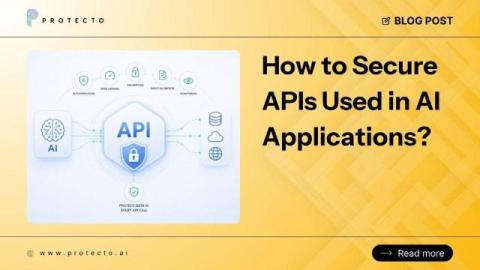
How to Secure APIs Used in AI Applications?

Every AI application runs on APIs. They carry prompts, responses, customer data, and credentials between your models, databases, and third-party services. To secure APIs in AI applications, you need strong authentication, rate limiting, encryption, input validation, and continuous monitoring. But AI adds a layer most API security checklists miss: the data inside the API calls. That data needs protection too.

How CISOs Track Configuration Drift in Real Time | Misconfiguration & Cybersecurity Posture

How do CISOs feel about drift? Misconfigurations rarely look like incidents. A setting shifts, posture weakens, and nothing announces it until it already matters. That is a hard seat for whoever owns posture. Without a clear view of what changed, you are working secondhand, leaning on the team to tell you what moved and whether it hurt.

Frontier AI Explained: A Guide to What Mythos, GPT 5.5-Cyber, MDASH, and CodeMender Really Do

The cybersecurity industry is entering a new phase of AI adoption. Frontier AI models are increasingly capable of identifying vulnerabilities, investigating threats, analyzing code, and accelerating security operations at machine speed. At the same time, innovation is moving rapidly. New models, platforms, and security-focused AI initiatives are emerging across the market, each pushing the boundaries of how AI can be applied to real-world cybersecurity workflows.

One Identity on Mythos, Fable and what they mean for your identity controls

Mythos changes the speed of attack. Identity controls decide what happens after. The shift underway For the first time in 19 years, vulnerability exploitation now leads the Verizon Data Breach Investigations Report as the breach entry point. It accounts for 31 percent of incidents, ahead of stolen credentials. Threat actors are using AI to exploit known vulnerabilities in hours rather than months. The Verizon data predates the latest frontier AI advancements.

Deconstructing the Agentic Stack: Why API Visibility Is the Ultimate Defense for AI Agents

AI agents do not create risk only when they hallucinate or produce an inaccurate answer. They create risk when they take the wrong action. A single user prompt can move through an application, reach an agent runtime, call a tool, trigger an MCP server, and touch a downstream API. By the time the action happens, the original request may be several layers away from the system that actually changes data, sends information, or executes a workflow. That is the problem security teams now face.

How to Validate Policy-as-Code Without Breaking Builds (Even When AI Writes the Code)

Picture two realities for the same compliance control reaching production. Reality One: Your AppSec team writes a new rule. An engineer uses Claude Code or Cursor to generate the OPA (Open Policy Agent) Rego policy in minutes. They deploy it. It blocks a legitimate release on a missing context variable, and the on-call engineer routes around the gate to ship the code. The AI gave them fast code — but not code they could trust.

How to Detect and Prevent AI Insider Threats

The rapid adoption of generative AI has transformed enterprise productivity, but it’s also quietly introduced a new, sophisticated vulnerability: the AI insider threat. For years, securing the internal perimeter meant watching for data exfiltration via USB sticks or unauthorized emails. Today, the risk looks entirely different.

Appknox vs Code-Centric SAST Tools: What Source Code Analysis Cannot See in a Mobile App

Your source code passed every scan. Every code review approved. Every linter ran clean. Your users just downloaded the compiled binary. Those are not the same artifact. Code-centric SAST tools analyze the code you write. Appknox analyzes what you ship. This is not a feature distinction. It is an architectural one, with direct consequences for what gets caught and what does not.