Security | Threat Detection | Cyberattacks | DevSecOps | Compliance

Agentic AI in Cybersecurity: The Complete Guide for Security Teams

Every modern engineering team pushes code multiple times a day. With each deployment, the attack surface shifts and expands in real time as new dependencies and configurations emerge. According to recent industry data, 16% of teams now deploy on demand or multiple times a day. At this pace, securing the attack surface with traditional pentesting is like playing an exhausting game of Whack-a-Mole, while here the targets never stop evolving and multiplying.

Full Fathom Five: The context of Anthropic's Mythos-class public release

This week bore witness to some interesting events and milestones as Anthropic announced the availability of Claude Fable 5, a descendant of their Mythos Preview model, and Microsoft published their largest Patch Tuesday in history with over 200 vulnerabilities. The two are not unrelated.

It's Not If Attackers Get In. It's What Happens Next | Insurity CISO Jay Wilson

"Usually it's not a question of if the bad guys get in. It's a question of what happens when they do." Jay Wilson, CISO and CIO at Insurity, and Garrett Hamilton, CEO of Reach, joined Shubhangi Dua on The Security Strategist from EM360Tech to talk about why the controls you already own are where exposure quietly builds up. That's Jay's line, and one every security leader has lived. Defense in depth only holds if every inner layer is configured the way you think it is. The outer door gets the attention. The inner doors are where incidents actually get stopped, or don't.

The Ultimate Guide to API Security in AI Applications

API security is the practice of protecting the interfaces that connect your applications, models, and data from unauthorized access, abuse, and data theft. In AI applications, APIs carry prompts, model responses, customer PII, and agent instructions, which makes them the single most exposed layer of your AI stack. Securing them requires authentication, rate limiting, encryption, and a layer most teams miss: protection of the sensitive data in every API call.

AI Data Exfiltration: Types, Risks, Prevention Strategies

Generative AI has revolutionized productivity — but it has also introduced a massive, often invisible new vulnerability: AI data exfiltration. Whether it’s a well-meaning engineer pasting source code into an LLM for debugging, or a marketer feeding sensitive customer data into a prompt for analysis, your organization’s most valuable intellectual property is likely walking out the virtual front door.

How to Secure AI Agents: 4 Best Practices

Imagine you give an AI agent permission to triage support tickets. A few weeks later, it’s accessing a system no one intended it to reach, putting the data within at risk of exposure or misuse. Nothing dramatic happens at the moment. That’s what makes the risk tricky. AI agents don’t wait for approval the way traditional systems do, and they move faster than the controls you’ve set around them.

7 Agentic AI Security Threats in DevOps That Multiply Your Attack Surface

AI adoption in the DevOps field has been extensive. Developers use agents daily to broaden context, automate coding, prototype, etc., saving time and minimizing the footprint of mundane tasks. But it’s not all about gains. Agentic AI enables and introduces security threats that were unknown just a few years ago. With machine speed and scale, these can impact your corporate repos in a number of highly dangerous ways. The trend is on the rise, including at the level of popular DevOps platforms.

Nightfall's integration with Claude's Compliance API is now live

What this milestone means for enterprise AI security - and why we built it. AI adoption inside the enterprise didn't slow down and wait for security to catch up. It accelerated. And nowhere is that more visible than in the rapid deployment of large language models like Claude across enterprise workflows. Customer support teams use it to summarize tickets. Legal teams use it to review contracts. Engineers use it to write and review code. Finance teams use it to draft reports.

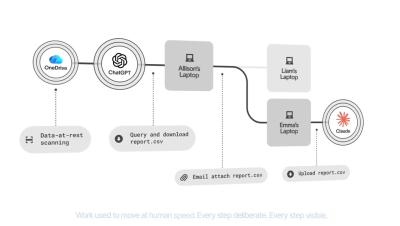
Claude's Agents Are Already Running Across Your Enterprise. Now Security Teams Can Catch Up.

We are excited to share that Zenity now integrates with Claude's Compliance API to bring Claude activity into the same AI security and governance platform enterprises already use to govern agents across the business. By combining Claude's Compliance API telemetry with Zenity's native agent security capabilities, security teams gain the visibility, posture controls, and real-time enforcement needed to secure Claude across the full agent lifecycle.