Security | Threat Detection | Cyberattacks | DevSecOps | Compliance

You Can't Have AI Security Without API Security: The Agentic Action Layer

AI agents run on APIs, and that is where most security programs have a gap. Salt Security Co-Founder and COO Michael Nicosia and CMO Michael Callahan explain why you cannot secure AI without securing the APIs underneath it. An AI agent uses an LLM to reason and an MCP server to broker calls out to other systems, and every one of those calls is an API interaction. Deploy one agent and the traffic multiplies. Deploy hundreds, and the internal east-west traffic climbs to several times what a pre-AI environment carried.

The Business Logic Paradox: Hackers Are Your Best Architects #businesslogic #cybersecurity #api

Here is the truth: To exploit Business Logic Abuse, hackers must understand your application flow holistically. Your individual developers focus on clean code within their one block. The attacker studies the entire blueprint and finds the gaps and missing connections between those blocks. They are committed-spending months on reconnaissance to know your product better than your own team. You must adopt the attacker's mindset in your design stages!

API Security for AI Agents: What CISOs Need to See, Govern, and Protect

AI agents are moving into every part of the business, and each one runs on APIs. Salt Security Co-Founder and COO Michael Nicosia and CMO Michael Callahan walk through what that shift means for security leaders. A single AI agent can generate thousands of API calls, and once agents start talking to each other through MCP servers and agent-to-agent protocols, the number climbs into the millions. That growth widens the attack surface and turns prompt injection into a common entry point.

Update on React Server Components RCE Vulnerability (CVE-2025-55182 / CVE-2025-66478)

The attack landscape has been dynamic following the disclosure of the React Server Components RCE vulnerability. New information has emerged regarding the initial Proof-of-Concept exploit, as well as improved detection methods, exploitation mechanics observed in the wild, and rapidly growing attack activity. This update summarizes the changes and observations we have made across Wallarm customers.

Agentic AI Security: The Emerging Fourth Pillar of Cybersecurity

For decades, cybersecurity has been organized around three dominant pillars: endpoint security, network security, and cloud security. These domains have shaped technology categories, vendor ecosystems, and enterprise budgets. They have matured into multi-billion-dollar markets, each responding to successive waves of digital transformation. However, a tectonic shift is underway.

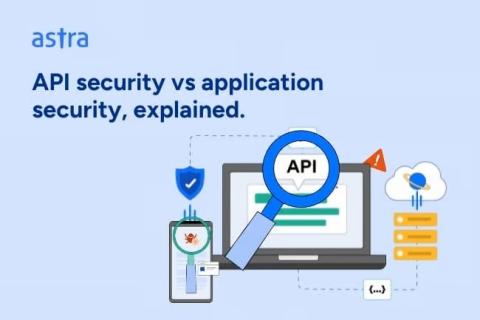
API Security vs Application Security: What's the Difference & Best Practices 2026

Over the past few years, APIs have quietly become the front door to your most critical data and workflows, flipping security ownership on its head. Accountability and ownership of both API and Application security have shifted from your central infra and network teams to product, platform, and engineering squads that ship new APIs every week, and well, sometimes every day. This is where CISOs and CTOs feel the tug strengthening from both sides.

Critical vLLM Flaw Exposes the Soft Underbelly of AI Infrastructure

While the world worries about "jailbreaking" LLMs or preventing them from hallucinating, a critical new vulnerability has just reminded us of a fundamental truth: AI is just software, and software has bugs. A newly discovered critical flaw (CVE-2025-62164) in vLLM, one of the most popular libraries for serving large language models, allows attackers to achieve Remote Code Execution (RCE) or crash servers simply by sending a malicious API request. This isn't a failure of the AI model.

APIs are the Language of AI. Protecting them is Critical.

APIs are the Language of AI. Protecting them is Critical. In this discussion, A10 Networks security experts Jamison Utter and Carlo Alpuerto explore the emerging impact of Agentic AI on the API security landscape. They delve into how AI agents, as new API consumers, are driving an explosion in endpoints and exacerbating existing security issues, pushing API protection higher up the security practitioners' priority list.