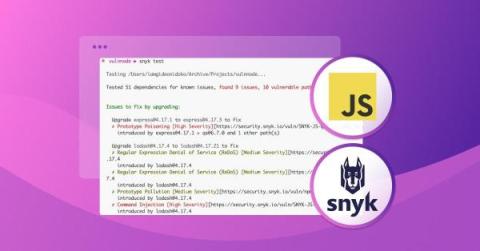
When web applications rely on user-supplied data, there is a potential risk of SQL injection attacks. SQL injection is a technique used to alter a SQL statement by manipulating user input. Specifically, attackers send malicious SQL code to the database to bypass security measures and gain unauthorized access to data. The consequences can be severe, ranging from sensitive information leaks to complete system loss.
According to Snyk's 2022 State of Open Source Security report, the average JavaScript project has 49 vulnerabilities, including common ones like unsafe dependencies, cross-site scripting (XSS), weak input validation, and cross-site request forgery (CSRF). And given JavaScript's widespread use, robust security measures are increasingly important to safeguard your applications from cyberattacks.
The JFrog Security research team constantly monitors open-source projects to find new vulnerabilities or malicious packages and share them with the wider community to help improve their overall security posture. As part of this effort, the team recently discovered a new security vulnerability in plexus-archiver, an archive creation and extraction package.
In recent years, blockchain technology has garnered significant attention thanks to its remarkable tamper-proof features and robust security. It is also expected that the blockchain technology market will exceed 1.2 billion US dollars by 2030, with an annual growth rate of 82.8 percent. However, recent headlines have exposed numerous vulnerabilities and cyberattacks targeting blockchain technology.
We just released a new Snyk Partner Speak Video to showcase Snyk and Slack’s joint integration that enables you to view and use Snyk data on Slack channels. The new Snyk App for Slack provides notifications within the channels your teams rely on most to address security issues in your code, open source dependencies, containers, and cloud infrastructure.
An exploit kit is a toolkit that cybercriminals use to attack the security vulnerabilities of a system or device to distribute malware. An exploit is a bit of code that takes advantage of security vulnerabilities found within software and hardware. Cybercriminals collect these bits of code and compile them into a kit that can target multiple security vulnerabilities at once, and secretly install malware on devices.