Security | Threat Detection | Cyberattacks | DevSecOps | Compliance

Recover OT Systems After Ransomware with Acronis Cyber Protect

When ransomware disrupts a manufacturing site, every minute of downtime matters. See how Acronis Cyber Protect supports the controlled recovery of engineering servers, SCADA systems and manufacturing databases from a last known good state, helping OT and IT teams verify system integrity and resume production with confidence.
SalatStealer Malware: Inside a Credential Stealer Built for Repeat Use

SalatStealer is a Go-based infostealer family first observed in August 2026, built for x86 Windows environments and focused on credential theft. Its documented capabilities include stealing authentication credentials, hiding executing code, and degrading security software.

Rubrik MSP Unscripted Episode 7 - Featuring Rajat Shah

In this episode of MSP Unscripted, Nawaz Ali sits down with Rajat Shah, Product Manager at Rubrik, to talk about the launch of multi-tenancy and what it means for managed service providers. Nawaz and Rajat discuss how shared infrastructure can help MSPs improve service economics while maintaining strong tenant isolation, expand opportunities across SMB and mid-market customers, and make services such as Backup as a Service, Disaster Recovery as a Service, isolated recovery environments, and advanced cyber recovery capabilities more scalable.

Graphalgo campaign spreads to Terraform providers and Go Modules

We’ve identified Go malware distributed via at least two Terraform providers and at least two Go Modules. This is the first time we’ve observed malware distributed via Terraform providers. The following packages contain the malware: The malware overlaps with the Graphalgo NPM malware campaign, first reported by ReversingLabs in February 2026, and also reported on in the last week by Safedep, CheckMarx, and JFrog.

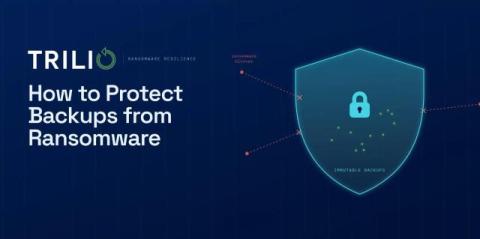
How to Protect Backups from Ransomware

Ransomware crews go after backups first. Before any production file gets encrypted, they hunt down your backup catalog, snapshots, and repository credentials. The real question is whether your backups can survive an attacker who is actively trying to destroy them. This guide covers how to protect backups from ransomware with specifics: immutable and WORM storage, the 3-2-1-1-0 rule, air-gapping, network segmentation, encryption, and access controls that hold up under pressure.

CISA: Ransomware Gangs Now Exploit Critical VMware vCenter Flaw

The U.S. Cybersecurity and Infrastructure Security Agency has warned that ransomware groups are now exploiting a critical VMware vCenter Server bug that Broadcom patched on 29 July 2026. The issue is CVE-2026-59310. It is a directory traversal flaw in the vCenter Syslog server. An attacker who can reach the server on the network does not need a password. Successful use can lead to remote code execution. The published severity score is 9.8.

PAPERMILL: Tracking an Emerging China-Nexus Malware Factory

JUMPSEC’s DART (Detection & Response Team) raised an alert to the Threat Research team regarding a specific ticket that arrived in a clients’ inbox, passing SPF, DKIM, and DMARC. The email contained an attachment and a subject which spoke about Tax Audits, that attachment, named “Tax_Notice_45594.exe” is not actually an exe but instead an.ISO. On the surface this looks like a fairly typical phishing lure, but the delivery mechanism underneath is anything but.

ParaShells: Parallels Desktop Turns Appliance Install Into a Root Shell

Your Mac runs a vulnerable version of Parallels Desktop. A malicious package, compromised CI job, or other unprivileged process is already running on it. No admin access. No Parallels-signed client. One appliance-install request later, attacker-controlled code runs as root. While testing Desktop 26.4.0 (build 57513) on Apple silicon, we found that an unprivileged local user could execute code as root through prl_disp_service.

Noodle RAT: A Recipe for Cross Platform Espionage

Noodle RAT—also known as ANGRYREBEL or Nood RAT—is a modular remote access trojan (RAT) with dual versions for Windows and Linux, actively used by Chinese-speaking threat actors since at least mid-2016. It was previously misclassified as variants of Gh0st RAT or Rekoobe but is now recognized as a unique backdoor family.
Featured Post

Why Data Governance Has Become a Critical Defence Against Ransomware in Healthcare

Ransomware and ransomware-style attacks can have a catastrophic impact within healthcare, where disruption directly impacts safety and continuity. Today's ransomware groups increasingly operate as sophisticated criminal enterprises, sharing tools, infrastructure, and expertise through ransomware-as-a-service (RaaS) models. This lowers the barrier to entry for cybercriminals while allowing experienced threat actors to focus their efforts on identifying and exploiting high-value targets.

WebInject: The Web Agent Prompt Injection With No Payload

A browser agent in your cluster opens a supplier portal, screenshots it, and clicks somewhere the task never called for. The page looks exactly like the page the supplier serves, and to the person who checks it later, it still does. The classifier in front of the agent returned nothing, because the instruction that produced the click does not exist.

Ransomware's AI Adoption Curve: From Marketing Claim to Operating Model

Somewhere in the first nine months of 2026, AI stopped being a talking point in ransomware and became part of how the work actually gets done. Tracking new ransomware-as-a-service (RaaS) launches, darknet recruitment ads and public incident reporting through this period shows a three-step progression: AI as advertising, AI as an assistant, and AI built directly into ransomware.

Ep. 79 - BeaverTail and InvisibleFerret: The Malware That Rewrites Itself for Every Target

North Korea has stopped writing bad phishing emails. In Part 2 of our DPRK deep dive, Tova Dvorin and Adrian Culley break down how the Reconnaissance General Bureau and Bureau 121 weaponized AI in 2026: Blue Noroff cloning a CFO's voice to authorize emergency liquidity transfers, real-time face swaps passing DevOps job interviews, and Lazarus using LLMs to polymorph BeaverTail and InvisibleFerret for every single target.

Ungentlemanly behavior: Insights into a ransomware operation

They call themselves The Gentlemen Behind the name is one of the most active ransomware operations of the past 12 months, linked to 683 victims and a playbook built around compromised credentials, legitimate tools, rapid privilege escalation, and aggressive defense evasion. In this video, Susie Evershed and Rafe Pilling break down the latest research from Sophos Counter Threat Unit (CTU), revealing how some affiliates can move from initial compromise to ransomware deployment in less than 24 hours.

MECCHA CHAMELEON can't hide from the RCE

TL;DR: We found another delayed RCE in MECCHA CHAMELEON. When playing on an attacker’s map, they can abuse an exposed function to arbitrarily write files to the victim’s system. This can lead to remote code execution on the victim’s system after a restart. We reported the issue to the game’s maintainers, and they fixed the vulnerability in the 4.0.0 update. This update is automatically installed before launching the game.

Block malware before it downloads: Configuring Download Filters in MSP Central

Imagine this: A cracked installer disguised as a productivity tool. An oversized file quietly eating into storage. An EXE attachment that never should have made it past the browser. Without a download policy in place, there's nothing stopping this from happening on any device—for any client at any time.

From Phishing to Persistence: Lessons from the CrySome RAT Infection Chain

Originally published on Cybersecurity Insiders. Phishing remains one of the most reliable entry points for attackers, serving as the initial intrusion vector in 58% of incidents analyzed in LevelBlue’s Q1 2026 TTP Briefing. But today’s campaigns are becoming increasingly targeted and technically sophisticated, evolving from simply convincing a user to click to establishing long-term access to enterprise environments.

How BlueVoyant and Partners are Detecting Modern Phishing Campaigns Across the Full Attack Chain Utilizing Microsoft's UEBA Capabilities

Over recent months, our Microsoft Managed Detection and Response (MDR) service, powered by the Threat Fusion Cell, has observed a sharp increase in sophisticated attack campaigns attributed to offshoots of threat brand Vocal Brigantine, who ceased operations in Spring 2026.

Peer Pressure: Inside the Sality Botnet Disruption Operation

On August 31, 2026, CrowdStrike's Counter Adversary Operations team, in collaboration with international law enforcement and industry partners, executed a coordinated disruption of the Sality peer-to-peer (P2P) botnet, a criminal infrastructure that has operated with seeming impunity for more than two decades. The botnet enabled the operator to distribute malicious payloads to over 15,000 infected machines worldwide.