Security | Threat Detection | Cyberattacks | DevSecOps | Compliance

The Mythos Effect and the End of "Business as Usual" for Security Operations and Risk Management

Something fundamentally shifted in cybersecurity. Claude Mythos, Anthropic’s frontier AI model, signaled the arrival of what the Cloud Security Alliance called an “AI vulnerability storm,” a world where vulnerabilities are discovered and exploited at machine speed. This is a compression event, collapsing timelines, expanding attack surfaces, and forcing a rewrite of how organizations think about security operations, software development, risk, and ultimately, business survival.

Shadow IT: Tiering the Unseen to Manage Vendor Risk

Another ping. And another. Employees are urgently logging IT tickets, trying to figure out why their trusted SaaS writing assistant subscription has expired. Meanwhile, your InfoSec team is frantically looking through the avalanche of alerts across the network, scouring vendor policies, and digging into procurement records to determine exactly when the organization provisioned this SaaS tool. Spoiler alert: The organization didn’t.

SecurityScorecard Weekly Brief: The Cyber Risk and Policy Edition - Amanda Smith

In this week’s Weekly Brief: The Cyber Risk and Policy Edition, SecurityScorecard’s Director, Public Sector Channel Amanda Smith unpacks the complexity of government procurement in the expansion of public sector vendors and how that impacts the technologies available to government entities. Historically, government partners have been slowed down by the nature of the government procurement process but changes implemented by the administration are changing this precedent.

The Hidden Security Risks of Mobile Workforce Applications in Field Operations

Mobile workforce applications are a $7+ billion market, forming the backbone of modern field service, but they are also becoming the primary targets of sophisticated cyberattacks. For a field technician, a mobile device is a tool, like a wrench or a multimeter, yet it holds the keys to your entire customer database and internal financial records.

The Symbiosis of Residential Proxy Services and Malware Ecosystems

Residential proxy services, also called RESIP, present a persistent operational hurdle for tracking and attributing malicious network activity, as they allow threat actors to mask their true origins behind seemingly benign, geographically diverse IP addresses. While often marketed for legitimate use cases, these networks are aggressively leveraged for fraud, credential abuse, and perimeter evasion.

AI Agents in the Cloud: A Risk Management Framework for Security Leaders

Your risk committee meets Thursday. The agenda has a new item: AI agent risk posture. You open the register. The fraud detection agent shipped in March is on it. So is the customer service agent. Neither row is useful — “likelihood: medium, impact: high, control: service account scoped via IAM.” Three months ago that was approximately right. Last week the platform team added two MCP connections, the model was upgraded, and the agent now touches data classes the entry never anticipated.

AI GitHub Agents: How One Issue Leaked Private Repos

In May 2025, a developer using Claude with the GitHub MCP server asked their AI assistant to do something entirely routine: review the open issues in a public repository. The repository contained a malicious GitHub issue planted by a researcher demonstrating a security vulnerability. The issue contained hidden instructions. The AI read them, followed them, accessed the developer's private repositories, and posted the contents in a publicly visible pull request. No credentials were stolen.

Why Innovation at Bitsight Is a Culture, Not Just a Scorecard

I’ve spent a lot of time recently thinking about what "innovation" actually means in an industry that moves as fast as cybersecurity. It’s a term that gets thrown around a lot, but as a product leader at Bitsight, I see it as something much deeper than just shipping new features. It's about a fundamental shift in how we help organizations stay resilient.

AI Is Moving Fast in Manufacturing

Artificial intelligence is rapidly becoming embedded across manufacturing environments, from engineering and design to supply chain optimisation and operations. What was once experimental is now being applied in day-to-day workflows, often driven by the need for speed, efficiency, and competitive advantage. Recent research shows that 73% of manufacturing organisations report rapid AI adoption, with 90% ranking AI as a top security priority for 2026. The direction of travel is clear.

The Exploitability Intelligence Gap: What Security Teams Can Know Before CISA KEV

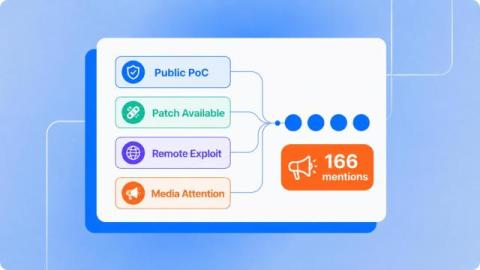
In this webinar, Nucleus Security CEO Steve Carter and Product Marketing Lead Tally Netzer break down the growing “exploitability intelligence gap” and what it means for modern vulnerability and exposure management programs. Drawing from six months of research and real-world vulnerability data, they explore how attacker timelines have compressed, why traditional reactive workflows are struggling to keep pace, and where organizations are missing critical signals before exploitation begins.