Security | Threat Detection | Cyberattacks | DevSecOps | Compliance

Overcoming Cybersecurity and Risk Management Challenges

Every time you leave your home, you take various risks, like being in a car accident or being struck down by a meteor. In some cases, like the meteor, the likelihood of the event is so low as to be nearly nonexistent. In others, like the car accident, the likelihood might be higher. Similarly, every technology that you connect to your networks creates a cybersecurity security risk. Any device or application that connects to the public internet can be an entry point for attackers.

The Rise of AI Abuse: A story of Criminal GPTs, DeepFakes, Data Breaches, AI Malware, and Agentic Sleeper Agents

In late 2022, AI exploded into the mainstream with OpenAI’s ChatGPT, starting an AI-fuelled shift in both everyday life and the cyber threat landscape. Just as quickly as everyday users rushed to adopt the technology, so did threat actors. From generating phishing pretexts to writing malware and crafting deepfakes, AI systems have become both a new tool and a new target.

10 Common Vulnerabilities Found During Software Audits - and How to Fix Them

A software audit is not a checklist but a thorough examination into the internal workings of your system that lurking vulnerabilities are usually hiding. Thousands of breaches every year are due to organizations not paying early attention to software audit vulnerabilities that might have been noticed and eliminated at an early stage. This article exposes the top ten vulnerabilities that are oftentimes encountered during software audits, why they occur, and offers some remediation measures that can be taken.

Total Cost of Ownership (TCO) for Cyber Risk Quantification

While the average costs of cyber events rise, so do cybersecurity budgets, albeit at an extremely minimal level. This fiscal reality, which will only become more pressing as organizations scale their cyber GRC programs according to the external risk landscape, has made it all the more critical for chief information security officers (CISOs) and other security and risk managers (SRMs) to be able to evaluate the ROI of the various solutions and initiatives they implement.

Data Overload in the AI Era: Why Aggregation and Prioritization Are Non-Negotiable

AI was supposed to make our lives easier. Vendors promised it would cut through complexity, detect threats faster, and lighten the load on already overworked security teams. But if you’ve been paying attention, you know the truth: AI has given us more noise than ever. Corey Brunkow from Horizon3.ai joined Nucleus co-founder and CPO, Scott Kuffer, to unpack this problem during a recent webinar. AI helps attackers move faster, but on the defensive side, it’s created a flood of data.

Critical Intelligence Alert: ED 26-01 - Action Required

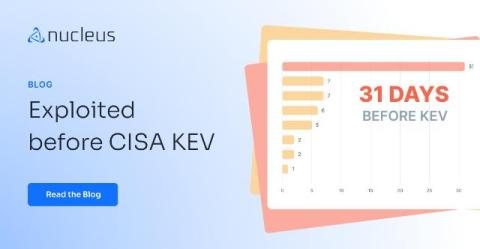
On October 15, 2025, the U.S. Cybersecurity and Infrastructure Security Agency (CISA) issued Emergency Directive ED 26-01, ordering federal agencies to mitigate a significant security breach involving F5 BIG-IP products. F5 disclosed that nation-state threat actors maintained long-term unauthorized access to internal systems, exfiltrating: This breach represents a major risk to organizations running F5 devices, especially those with exposed management interfaces or unpatched systems.

Security Starts Left of Boom: Pre-Event Strategies for Proactive Risk Reduction

For years, cybersecurity has lived under a grim banner: “It’s not a matter of if you’ll be breached, but when.” That phrase became the industry’s guiding principle. Relying on prevention alone was slowly written off as impossible. Instead, the dominant wisdom declared that organizations must accept compromise as inevitable and prepare to deal with attackers after they had already gained a foothold.

Can Trading Education for Active Futures Traders Help Secure Your Investments?

Here's something uncomfortable: most futures traders bleed money during their first twelve months. This isn't speculation; it's a brutal pattern that shows up in every market cycle without fail. What separates the survivors from the statistics? Usually, it's education. But here's the real question you're probably asking yourself: Does structured learning genuinely protect your capital, or is it just another line item draining your account? The answer lives somewhere in the gray zone.